Categories
Microscope

How this researcher reached the world by writing on Medium

“I just decided to publish my story here and see what happens…I woke up one morning, and I was getting so many people clapping. One person had commented. And then I started noticing people highlighting deep into the article. It was a 2,000-word article!”

Behavioral scientist 

Maria Keckler, Ph.D. came to Medium because she had a story she wanted to share with the world and didn’t want to wait for the slower traditional publishing route.

So she posted it on Medium.

Since then, she’s reached “decision makers, directors, VPs, people leading, UX designers,” on and off Medium.

I enjoyed her write-up of her experience on Medium, so I reached out to ask her to speak with me. Here’s what we discussed:

Table of Contents

· Dr. Maria Keckler, please introduce yourself.
· Tell me about your background, your research, and writing on Medium
· What brought you to write on Medium?
· How does writing on Medium compare with elsewhere online?
· What has been your proudest Medium accomplishment since you started writing here?
· What’s your writing process?
· How do you simplify technical concepts in your writing?
· What is your favorite Medium feature?
· Do you have any tips for new writers on Medium who want to share their story?

This is a lightly edited transcript of our interview.

Want to watch the whole interview? Check it out below:

https://cdn.embedly.com/widgets/media.html?src=https%3A%2F%2Fwww.youtube.com%2Fembed%2F4rOWArniUDw%3Ffeature%3Doembed&display_name=YouTube&url=https%3A%2F%2Fwww.youtube.com%2Fwatch%3Fv%3D4rOWArniUDw&image=https%3A%2F%2Fi.ytimg.com%2Fvi%2F4rOWArniUDw%2Fhqdefault.jpg&type=text%2Fhtml&schema=youtube

Zulie RaneMaria Keckler, Ph.D., please introduce yourself.

Dr. Maria Keckler: Thank you so much, Zulie. Such a delight being here with you. I am Maria Keckler. I am a research scientist. I am also a writer and storyteller. I love telling great stories to make academic research more accessible and share some of the insights that all of us can apply to our lives.

Tell me about your background, your research, and writing on Medium

MK: For me, writing comes naturally. Before becoming a research scientist and academic, I was in communications for twenty years. Even to this day, I work with companies or executives helping them extract the story behind their message.

I’m always waving the banner: Please tell a story. What is the story? People may think I sound like a broken record. For me, the story is just crucial.

My research is about the neurobiology of storytelling. We know from research that when we communicate with stories, there is activity in our brain that helps us connect, be more empathetic towards each other, and trust each other.

In a previous life, I was a technical writer. One of the things that we can learn from great storytellers and technical writers is that it comes down to the audience first.

If we don’t think about the person on the other side reading it, then we’re just having a monologue.

Number one, that writing is not as fun. Number two, that won’t reach an audience, and it doesn’t have as high an impact on their lives.

What brought you to write on Medium?

MK: Rebranding soft skills to structural skills. For many years, even decades, I have been saying we need to stop calling them soft skills. These are the skills of communication, leadership. These are critical skills that we need every single day.

As an immigrant, it was my soft skills and working in a very focused way on the soft skills that helped me get ahead and advance in my career.

As I started thinking about how we can change how we see them, I thought we should call them structural skills.

I decided to submit an article to a well-known publication. I had a lot of dialogue when I posted about it on LinkedIn, so I thought, great, let’s publish an article about it.

And I didn’t hear anything.

Crickets.

For those of us who chase the traditional publication model in academia, that’s normal. We just look for another publisher.

But today, with change being so fast, we cannot afford to wait around for somebody to tell us we have permission to publish something.

I had been curious about Medium because I read here. I have always been impressed with the writing. The visual design feels very elegant to me.

I am impressed that here, people actually read long form. When you spend a lot of time on LinkedIn or social media, you begin to believe that people no longer read. If you don’t put it into three bullets or 10 points or two tips, people don’t want to read anymore.

On Medium, there was an audience for long-form writing.

I just decided to publish that story here and see what happens. Then I thought, I’ll write an article for each one of those skills I mentioned in my article.

When one of my stories was Boosted by Medium, I woke up one morning, and I was getting so many people clapping. One person had commented. And then I started noticing people highlighting deep into the article. It was a 2,000-word article!

Then I saw someone saved it on this List called, “You need to read.” Another one saved it to a List called “Career.”

As a researcher, I thought, oh my gosh. This is incredible data, how people are absorbing this information, where they’re storing it, and how they’re engaging with it. I was blown away. It’s been surreal to see how many people have engaged with it.

How does writing on Medium compare with elsewhere online?

MK: I had a blog many years ago. Two things were so frustrating. Number one, finding an audience because it takes a long time. Number two, if something broke in the blog, I had to find somebody to fix it. It was a lot of maintenance, worrying about whether it was gonna work, how am I going to bring people here. And I began to lose my true love, which is writing.

On Medium, connecting with people has been so rewarding. Readers highlighting, engaging, all of that.

And then I started noticing that people that I wanted to reach — decision makers, directors, VPs, people leading, UX design — people that I want to work with, people I want to meet? They started sharing the articles on their own LinkedIn profiles. They would tag me and start a conversation. “I’ve been talking about this, and Maria frames it this way.”

I thought, oh my goodness. These people were from all over the world, which is another thing that was just remarkable to me in Medium, how it attracts people from all over the world.

I started thanking readers for sharing it — and then asking to learn more about what resonated, how it applied to their industry.

Just last week, I was on these virtual coffees with somebody from South Africa, from Australia, from the UK, from Glasgow, from Kenya, and across the US. I’ve already met with 15 people.

ZR: Wow. That’s almost every continent.

MK: To me, being able to write something that gives me real feedback and to see which ones are resonating versus others — it’s a little experiment.

Then to be able to see what resonates and to have a way to connect with those individuals is amazing. It’s been very, very fun.

I started publishing without a paywall. Then I thought, you know what? I’m gonna see what it would look like to turn on the paywall. I turned on the paywall, and just like that, I already paid for my Friend of Medium membership.

I’ve also enjoyed meeting other academics who are making an effort to make their writing accessible. That has been really wonderful, which motivates me to bring more of my colleagues to the platform for sure.

What has been your proudest Medium accomplishment since you started writing here?

MK: You know, it has made me want to write. In a month and a half, I’ve published nine or 10 articles that I’ve been tinkering with for a long time, that I’ve had on my notes or Google documents.

I didn’t just start from scratch. I’m a writer, and so I’m always writing. I have so much content, but it’s always been, well, one day, I will make this into a book. Someday, I will do this.

The thought of constantly having to pitch to publications, it just is so laborious when I have so much work with my research, with my business, and then I wanna write.

For me, the discipline has been my proudest moment because I can go grab a piece that I’ve been working on for a long time and say, you know what? I’m gonna finish it.

I have 860 people who decided they want to follow my work. I started a publication to organize these articles, and over 500 people have decided to subscribe to that in a little bit over a month and a half.

I feel like these people want to know what’s the next piece. It inspires me to show up with that value add for them because they took the time to say, “Yes. I care about what you’re writing. I care about craft as well.”

I also find the comments very inspiring — people are truly engaging in conversations. I respond to every comment.

I have also found that I want to read what other people are writing. I want to comment; I want to be generous in that way because I don’t want to just show up to take, you know, read my stuff. I also want to engage with the work, and I found some phenomenal pieces.

I love these writers:

One of the pieces that surprised me was by 

James Horton, Ph.D. He’s also a social scientist, and his piece was featured by Medium in Staff PicksThings You Learn from Skimming 1,350 Academic Journal Articles.

I was so blown away by the writing and visual storytelling, how he used AI to create some whimsical dividers through his story. I just found it so phenomenal.

I wanted to read more of what he’s writing.

It’s just a perfect example of someone who is writing about something that could potentially be a drag to read, but you can relate to it. It is a wonderful perspective to bring to readers.

What’s your writing process?

MK: A lot of the writing process first happens in my head. I am thinking about it constantly. Right now, I’m thinking of my next piece about pivotal optimism as another core skill that we need today.

I ask myself, what is the story that I want to tell that is very personal? What books have I read that talk about it? Is there some data point? How do I pass the ball to the reader so they can see this relates to them?

For me, that process is mental.

I take notes in my Apple Notes. I read. I go to the library, I’ll find a book, grab a quote.

Once that finishes organically, I use a free write device, which is like a keyboard with no Internet. I just write and it goes into the cloud, so that I am not distracted by Internet, by notifications, by AI.

I do a brain dump of everything. It’s very freeing because it’s just the first draft.

I came to the United States as a new immigrant when I was sixteen. I was born in Mexico City. I couldn’t speak English, but I was a really good typist on the old traditional typewriter. In those days, they had a typing class. There was a competition for typing accuracy and speed. I didn’t have to understand what I was typing. I was just sight typing, and I won an award for typing. It was just so cool. That concept really spoke to me of really having the freedom to just type without worrying about the end product.

Once I have a pretty good copy, then I go to AI and ask it to give me a proofread, and tell me what I am missing.

I try to use AI almost like an editor, like someone would use a traditional editor. For me, AI is great for feedback. It’s never good for truly finishing a piece. It almost feels like it wants to take over my voice.

Once I decide that I want to finish a piece, it’s all-consuming for me, even if I have other pieces going on. I go in and I get very obsessive.

How do you simplify technical concepts in your writing?

MK: I try to explain it as I would to an eight-year-old. It forces you to go from an abstract, complicated, technical concept in a way that you would explain it to your own child, a grandchild, a niece or a nephew.

If you’re able to do that, you’re going to discover that part of you that can tell that story. If that becomes too hard for you, that’s a great use for AI. Ask, how would you explain this to an eight-year-old? Just to get your brain in that space. From there, you can begin crafting the story based on that simple concept.

Social scientists or those in the hard sciences, we have such incredible work that should be read by more people. Not just the few who are getting academic articles and can understand them. My dream is that more of them come to bring that value to Medium, and share what has been maybe kept in a vault for a long time.

What is your favorite Medium feature?

MK: I really love the Friend link because I can send my writing to people. I keep a list of my Friend links and send them out to people. It just feels very generous to do that.

All my stories were free originally. I didn’t know they were gonna go viral. I just wanted to get it out there.

But now, I paywall them and share Friend links because I want to be generous with Medium and its readers. I know there is that generosity to the people that are not Medium members, that I want to invite into my writing. I also want to be generous to the process of the platform and, and honor how they have created this way to reward writers.

It just gives me a great way to be generous in multiple ways.

Do you have any tips for new writers on Medium who want to share their story?

MK: Yes. I would say start. You just have to start.

For me, having this thirty-day experiment, I had low expectations and just did it, and I just wanted to learn something from the process.

I would say just do that. Give yourself thirty days and publish a few articles. Try to see it as a true experiment where you are not discouraged if you don’t have a viral moment.

If your first piece, second piece is not going viral, if you don’t have a thousand claps, if you don’t have all of that, it’s still very valuable.

It teaches you how to write in such a way that connects with the audience. If people are not reacting to it, they’re not connecting? That’s great data. Maybe it’s your heading, maybe it’s your title, maybe it’s the storytelling techniques, maybe it’s a topic. Whatever it is, it’s an incredible way to learn how to be a better writer and storyteller and how to connect with your audience.

Use it to hone your writing, to connect with people you have been wanting to reach, and then improve from there.

Learn about your voice. I’ve read a lot on Medium about how to get more views, how to write more articles, how to get more clicks — things that are very practical. But at the end of the day, I do not want to gain followers or get clicks by writing as someone else.

I could build a huge audience by not being me. But the benefit of writing is just being who you are. Oftentimes, we have to go back to the moments in our story that give us those clues about who we are.

In summary: Just show up as the most authentic you. Learn the craft to do it well. Then you’ll begin to attract the people who are looking for you.
Categories
Microscope

Working Distance – Definition, Measurement, Types, Importance

[bno_ai_ask_button]

What is Working Distance?

In optics and microscopy, working distance—a fundamental idea—is the empty space between the object of view and the front surface of the lens or lenses in a microscope. Measuring in millimetres (mm), this distance greatly influences our perspective of objects under microscopes.

Consider yourself examining little items under a microscope. Between the lens and the object, the working distance functions as the “breathing room.” It’s crucial as it controls the object’s distance from the lens while nevertheless maintaining focus’s accuracy. The range runs from the moment the item is closest to the lens until it looks to be rather far away.

Fascinatingly, the operating distance of the microscope increases less as you raise the magnification to view objects closer. It’s like zooming in on a picture: the less space there between the lens and the item the closer you zoom in. This is thus because increased magnification requires certain lenses with larger “eye openings,” which lowers the distance they can operate with efficiently.

These lenses are painstakingly designed by manufacturers. They look for a mix between ensuring they can still focus correctly even when the item is not exactly up close and making the lenses strong so you can see little objects.

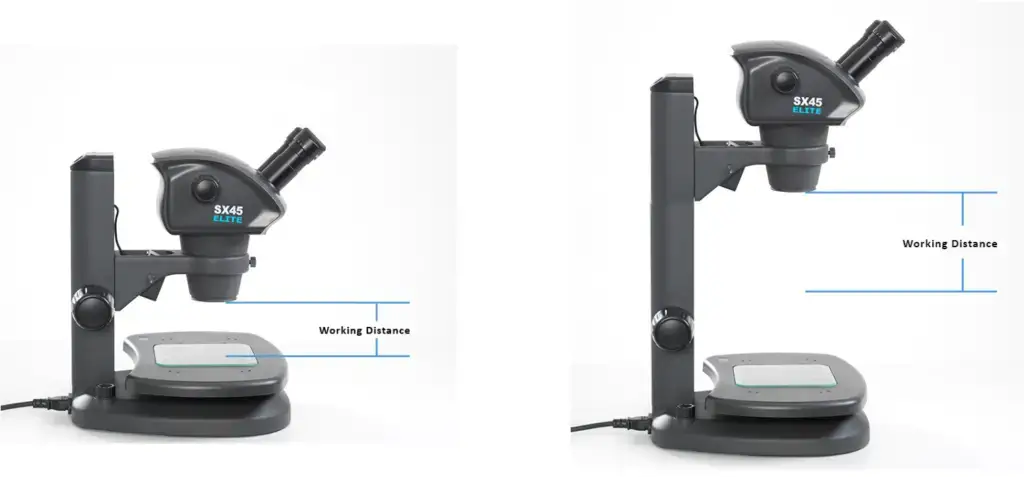
Working distance is not the same as another word used, “front focal distance,” which gauges the distance from the lens’s front surface. In stereo microscopes, some people also define working distance differently, maybe from the base of the microscope or the lowest optic.

Most importantly, though, is the distance separating the lens from the item you are examining. It resembles the gap between the lens and the slide in a stereo microscope. That is the point when the thing appears to be rather crisp and distinct.

Here’s a fun tip: you have seen the value of working distance if you have ever unintentionally banged a microscope lens against a slide and felt relief that it did not break. Much depends on the distance separating the slide from the lens.

Simply said, therefore, working distance is the difference between your lens and what you are viewing. It influences your clarity of vision, particularly in relation to a significant magnification. Though they magnify the same, various lenses have varying working distances. Knowing working distance can help you select the correct lens for your travels throughout a microscope.

What is working distance in Microscope?

dfgfdg

When talking about microscope, the word “working distance” has more than one meaning. Some experts say it refers to the space between the base of the microscope and the thing you’re looking at. Some say it has to do with the distance from the lowest lens’s surface or a similar point of reference. No matter the point of view, the important thing is still the space between the lens and the point where the subject becomes clear.

When talking about microscope, the word “working distance” has more than one meaning. Some experts say it refers to the space between the base of the microscope and the thing you’re looking at. Some say it has to do with the distance from the lowest lens’s surface or a similar point of reference. No matter the point of view, the important thing is still the space between the lens and the point where the subject becomes clear.

It’s important to keep this separate from the place under the stereo microscope, which also needs to be big enough for the thing being studied. The working distance stays the same, but the position of the microscope can be changed vertically to make it easier to place objects correctly.

dfgfgfggdfgfdgfgdg

If everything went perfectly, these little details might not matter, and there would always be plenty of room to try new things. But in the real world, physics rules apply, especially when it comes to how in-focus zoom and distance from the lens affect each other.

In order to change the working distance of a stereo microscope, the objective lens must also be changed. These lenses are at the end of the microscope that faces the object being studied. They can be used to make things bigger or smaller. They change not only the resolution but also the distance at which you can work.

If you choose a higher-power objective lens, the total magnification will be higher, but the working distance will be shorter. On the other hand, adding a lowering objective lens lowers the total magnification and increases the working distance. Researchers and microscopy fans can change the way they use microscopes to fit their needs thanks to the way objective lenses and working distance change over time.

The working distance in microscopy is the space between the objective lens of a microscope and the point where it is focused perfectly on a subject. It is a complicated measure that is affected by objective lenses, magnification, and practical concerns. These factors all add to the art and science of studying tiny objects.

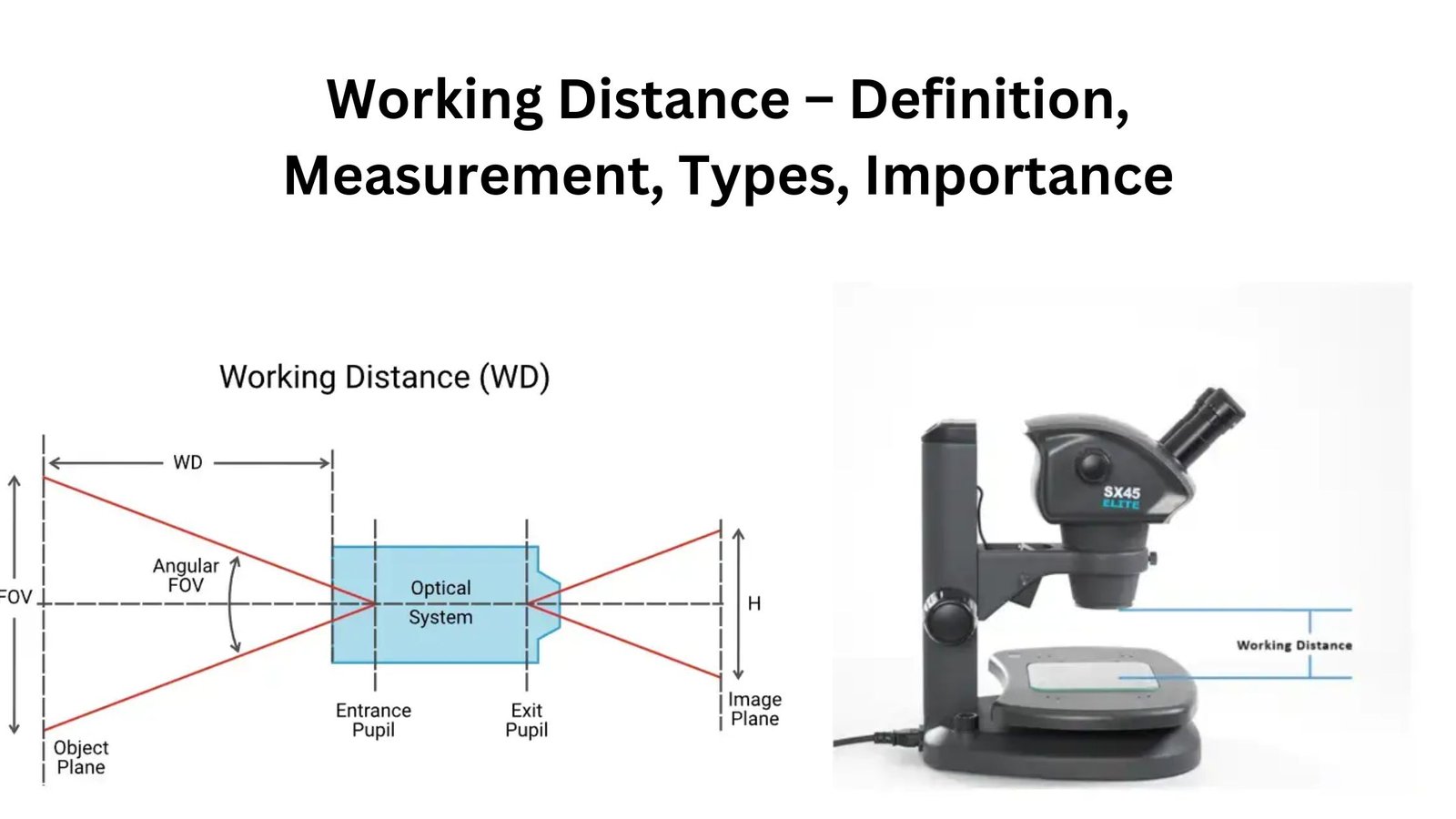
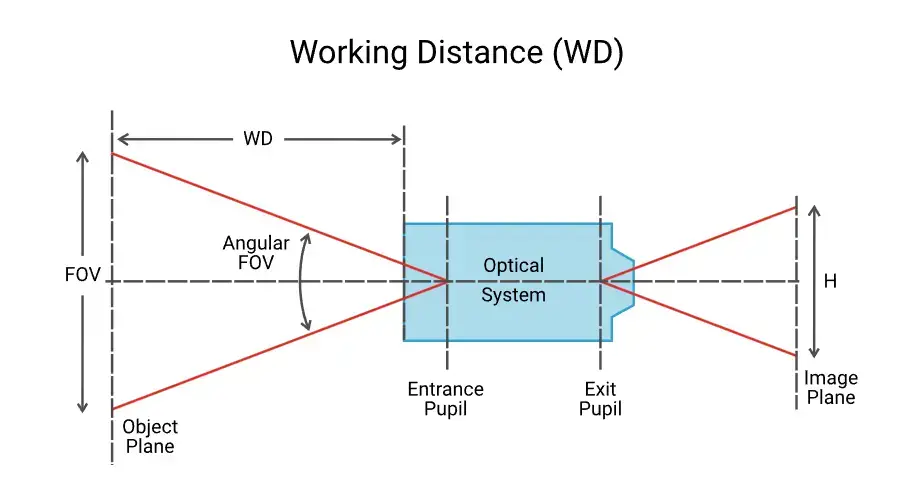
Relationship between Working Distance (WD), Field of View (FOV), Angular Field of View (AFOV), and the sensor size (H).
Relationship between Working Distance (WD), Field of View (FOV), Angular Field of View (AFOV), and the sensor size (H). | Image Credit: https://www.meetoptics.com/academy/working-distance#what-is-the-working-distance-of-an-optical-system

What Are the Different Types of Working Distances in a Microscope?

Microscope working distances fall into two categories:

  • Objective Working Distance: The distance between the optical instrument’s front lens and the object’s nearest component. The space you have to deal with to place the thing beneath the lens and make it visible. Measurements sometimes include the slide cover.
  • Stage Working Distance: You may see this space when moving the microscope’s tube, arm, or stage. This determines how thick or huge an object may be while still being visible at the goal working distance. Longer distances are preferable for viewing bigger items.
What is working distance in Microscope?

How Does It Work?

  • It’s important to know how a microscope works, especially when looking at different things. It is very important to keep the right spacing between the microscope and the thing you want to look at. You need to move the lens farther away from some things because they might be dangerous or not flat.
  • This is a useful measurement for microscopes when you need more room between the lens and the thing you want to look at. Things tend to get closer when you zoom in a lot, making the working space shorter. The working distance gets shorter as the zoom level goes up, though.
  • Use different glasses to change the distance you can work at. The part of the microscope that looks at the item has these lenses on it. They can zoom in or out, and they can also change how far away the lens needs to be.
  • When you put on a magnifying lens, the item appears larger, but you must approach it closer. And if you put on a lens that makes things look smaller, you can be farther away from the thing that is smaller.
  • Working distance might be 50 millimetres (your thumb) or 0.1 millimetres. The working distance shrinks as you zoom in and make things clearer.
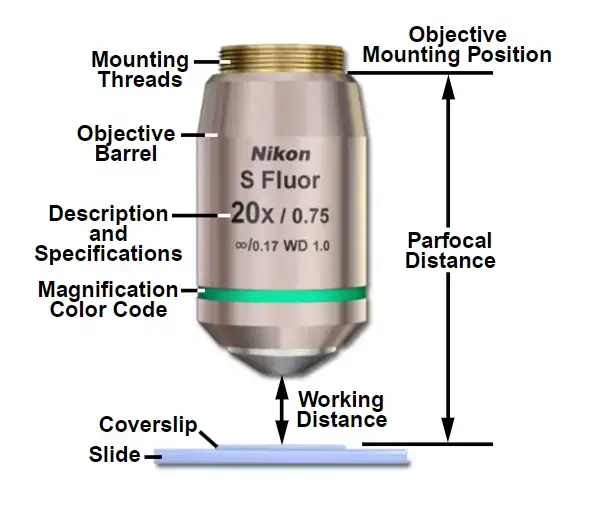
Objective Working and Parfocal Distance
Objective Working and Parfocal Distance | Image Source: https://www.microscopyu.com/microscopy-basics/working-distance-and-parfocal-length

How to Find the Working Distance for an Objective Lens

Effective usage of a microscope and correct focus depend on knowing the working distance (WD) for an objective lens. Under sharp focus, the working distance—that is, the area between the objective lens and the specimen—is basically constant. The type of objective lens you are using can greatly affect this distance; knowledge of this will help avoid harm to your sample as well as the lens.

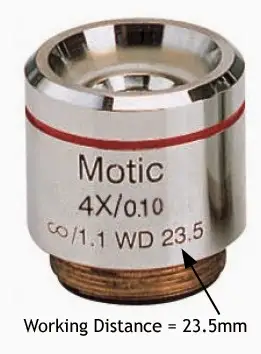
  • Review the Specifications- Referring to the specs of the objective lens or microscope can help one determine the working distance the easiest. Usually found on the side or identified in the accompanying literature, objective lenses have their WD printed there. Usually expressed in millimetres (mm), this information will save you time and conjecture if you know this.
  • Review the Specifications- Referring to the specs of the objective lens or microscope can help one determine the working distance the easiest. Usually found on the side or identified in the accompanying literature, objective lenses have their WD printed there. Usually expressed in millimetres (mm), this information will save you time and conjecture if you know this.
  • Refer to the Magnification Chart; generally, shorter working distances correspond to higher magnitudes, say 100x or 200x. You can therefore approximatively determine the working distance knowing the magnification. A 4x objective lens might have a working distance of about 20 mm, for instance, whereas a 100x objective lens might have a WD as little as 0.2 mm. This will enable you to estimate the required space for handling particular lenses.
  • Refer to the Magnification Chart; generally, shorter working distances correspond to higher magnitudes, say 100x or 200x. You can therefore approximatively determine the working distance knowing the magnification. A 4x objective lens might have a working distance of about 20 mm, for instance, whereas a 100x objective lens might have a WD as little as 0.2 mm. This will enable you to estimate the required space for handling particular lenses.
  • Measuring Directly: Should the WD not be found in the specs, a quick fix is to measure it yourself. Starting with the objective lens above a cover slip or flat surface, gently pull it down under view through the eyepiece. Once you have focus, find the distance separating the lens from the specimen using a ruler or measuring calliper. Though it will get you an exact measurement for that particular objective lens, it is a little more laborious.
  • Measuring Directly: Should the WD not be found in the specs, a quick fix is to measure it yourself. Starting with the objective lens above a cover slip or flat surface, gently pull it down under view through the eyepiece. Once you have focus, find the distance separating the lens from the specimen using a ruler or measuring calliper. Though it will get you an exact measurement for that particular objective lens, it is a little more laborious.
  • Knowledge of the several kinds of objective lenses is important. Usually, a compound lens with high magnification will have a shorter working distance than an objective with lesser magnification. This is so because more exact lens placement closer to the sample is needed for higher magnification.
  • Working distance of an objective lens depends also on its numerical aperture (NA) influence. Higher NA lenses might show a shorter WD. This is so because these lenses’ enhanced light-gathering capacity lets them operate more effectively but within a limited distance.
  • Sometimes the fine focus mechanism of your microscope could also influence the working distance of your microscope. Should you find that changing the fine focus alters the apparent working distance, it is crucial to strike the ideal balance between object position and clarity.
  • The Value of WD: Remember that handling specimens or using immersion oils can make a quite short working distance challenging. It can make it more difficult to view your sample correctly or unintentionally cause the lens to come into touch with the specimen. Conversely, a longer working distance might give more room to move your sample, but it might not deliver the clarity of the greater magnificiencies.
How to Find the Working Distance for an Objective Lens
How to Find the Working Distance for an Objective Lens  | Image Source: https://blog.microscopeworld.com/2014/08/microscope-working-distance.html

Importance of Working Distance in Microscope

  • Depth of field – The working distance directly impacts how much of your sample remains in focus at once, where longer distances generally provide better depth perception whilst viewing specimens.
  • Image Resolution— A shorter working distance typically yields higher resolution images, as it allows the objective lens to capture more detail from the specimen being observed.
  • Safety considerations – Maintaining proper working distance helps protect both the specimen and expensive microscope components from accidental damage during focus adjustments.
  • Stereo microscopes– These microscopes need longer working distances compared to compound scopes, as they’re frequently used to examine larger specimens and require space for manipulation.
  • Illumination requirements – Like most microscopes, proper lighting becomes crucial at different working distances, where shorter distances may need specialized lighting solutions whilst longer ones offer more flexibility.
  • Sample manipulation– The working space between objective and specimen determines how easily you can handle, adjust or modify samples during observation.
  • Objective lens specifications— Different magnification levels require varying working distances, where high-power objectives typically have shorter distances compared to low-power ones.
  • Environmental factors – Temperature changes and vibrations can affect the working distance, requiring careful consideration during prolonged observations.
  • practical applications– Industries such as electronics and material science rely heavily on specific working distances for quality control and research purposes.
  • specimen thickness– The working distance must accommodate samples of varying depths, especially when examining thick or three-dimensional specimens.
  • Ergonomics – proper working distance contributes significantly to user comfort during extended microscopy sessions, helping reduce eye and neck strain.
  • Focus stability– maintaining consistent working distance throughout observations ensures stable focus and reliable imaging results.
  • accessory compatibility— The available working space determines which additional tools and accessories can be used with the microscope setup.
  • calibration requirements– Regular checking and adjustment of working distance helps maintain accurate measurements and consistent imaging quality.
Reference
  1. https://www.visioneng.us/resources/articles/working-distance-a-simple-explanation/
  2. https://opticsmag.com/what-is-working-distance-in-a-microscope/
  3. https://microscopeclarity.com/what-is-working-distance/
  4. https://www.e-education.psu.edu/mcl-optpro/theory/node801
  5. https://www.olympus-ims.com/en/microscope/terms/working_distance/
  6. https://www.rp-photonics.com/working_distance.html
  7. https://blog.microscopeworld.com/2014/08/microscope-working-distance.html
  8. https://www.celestron.com/blogs/knowledgebase/what-is-the-working-distance-of-my-microscope
  9. https://pages.mtu.edu/~shene/DigiCam/User-Guide/Close-Up/BASICS/Working-Dist.html
  10. https://www.vision-doctor.com/en/optical-calculations/calculation-working-distance.html
  11. https://sciencing.com/difference-between-compound-dissecting-microscopes-5576645.html
  12. https://www.meetoptics.com/academy/working-distance
  13. https://www.newport.com/f/long-working-distance-objectives
Categories
Microscope

Pocket Microscope – Definition, Parts, Principle, Uses, Types

What is a Pocket Microscope?

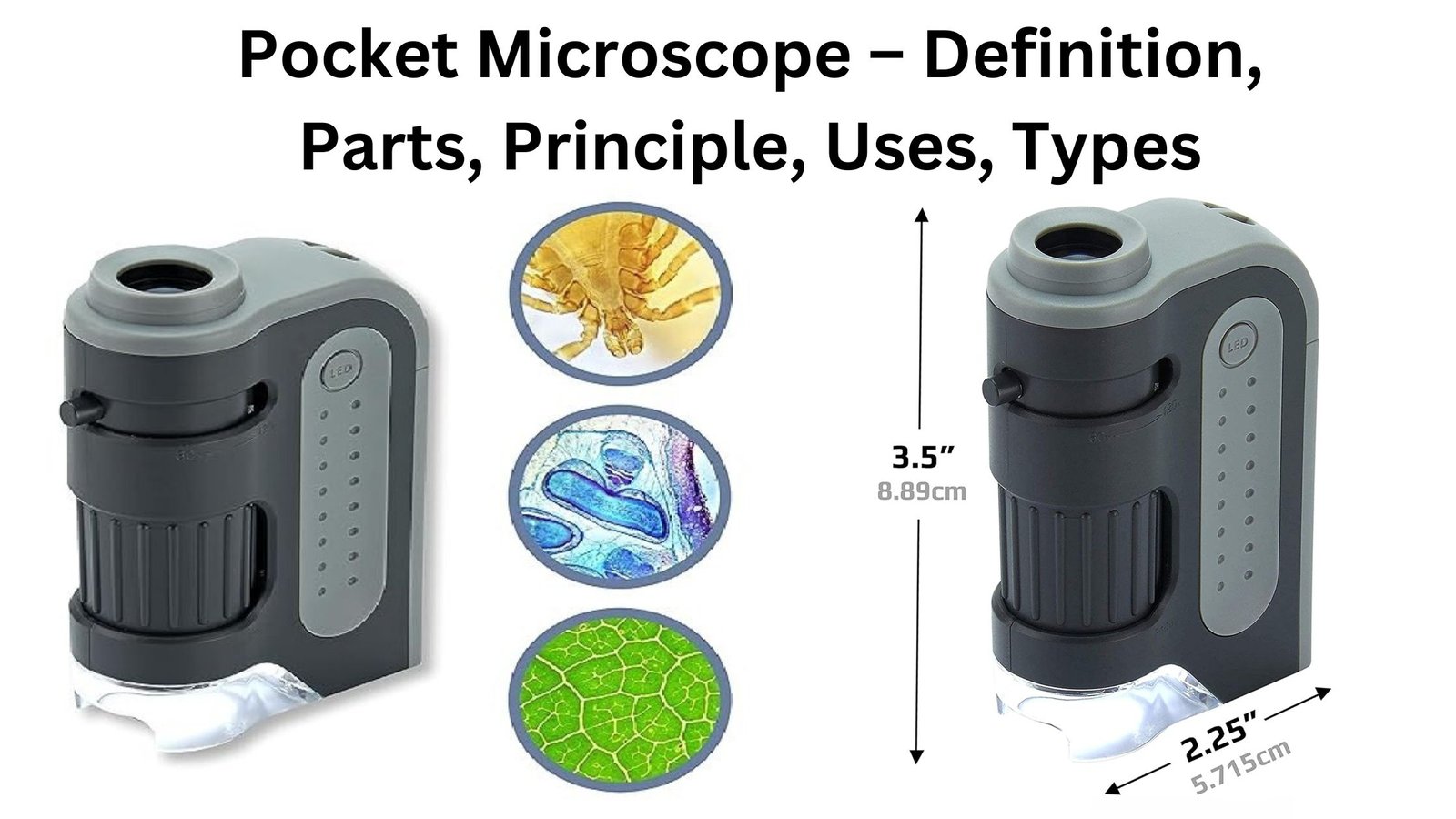
A pocket microscope is a compact optical instrument that professionals and hobbyists alike can utilise. These microscopes– which are specifically engineered to be portable, feature a diminutive form factor that makes them truly pocket-sized, though certain models are marginally larger.

ghgfhgfhgfh

Like most microscopes, they incorporate a small platform for specimen observation, yet their compact nature means they cannot accommodate a mirror system to properly orient the image. Despite this limitation, these portable instruments serve both casual enthusiasts and trained specialists, depending on their specific requirements.

Like most microscopes, they incorporate a small platform for specimen observation, yet their compact nature means they cannot accommodate a mirror system to properly orient the image. Despite this limitation, these portable instruments serve both casual enthusiasts and trained specialists, depending on their specific requirements.

The microscope’s miniature design enables users to carry it about effortlessly, making it a practical tool for field research or quick examinations. whilst its compact dimensions might suggest limited capabilities, these portable microscopes– sometimes called pocket scopes by enthusiasts, can deliver surprisingly detailed observations.

These portable optical tools maintain functionality despite their reduced size, though naturally, they mightn’t match the capabilities of their full-sized laboratory counterparts. Nevertheless, they’ve become increasingly popular amongst various users, from students to professional researchers, owing to their convenience and practicality in diverse settings.

The design prioritises portability without completely sacrificing optical performance, making these instruments particularly useful for quick observations outside traditional laboratory environments. Their versatility allows both amateurs and professionals to conduct basic microscopic examinations wherever they might be needed.

Principle of Pocket Microscope

Most pocket microscopes feature a straightforward design principle– they consist of an eyepiece positioned at one end whilst a light source occupies the opposite end, accompanied by a compact stage for specimen placement. However, certain models lack this specimen stage altogether.

These compact optical instruments demonstrate fascinating variability in their construction. When a stage is absent, users must position the microscope directly above the specimen at an appropriate viewing angle. Some pocket scopes incorporate mirrors and specialized lenses to magnify specimens, though this often results in an inverted image.

The principle behind these portable microscopes is rather intriguing, as their diminutive size presents unique design challenges. Whilst larger microscopes typically employ mirror systems for image orientation, pocket microscopes often lack this capability due to their compact nature. This limitation stems from their reduced dimensions, which simply cannot accommodate the necessary mirror arrangements to properly orient the viewed image.

Like most optical instruments, these portable microscopes rely on fundamental principles of light manipulation and magnification. The basic components work in harmony to deliver a magnified view of specimens, though the exact configuration may vary betwixt different models. Some sophisticated versions might incorporate additional features, whilst simpler variants maintain a more basic arrangement of components.

The operational principle remains relatively straightforward, despite variations in design. Light passes through or reflects off the specimen, travelling through the optical system to present a magnified image to the observer. This fundamental approach to microscopy persists, even in these miniaturised versions, though certain compromises in image orientation might be necessary due to size constraints.

Parts of a Pocket Microscope

  • Light source – Its an LED light source placed at the end of scope that helps to illuminate objects whilst viewing.
  • Eyepiece– The eyepiece helps you to view objects and specimens through the microscope.
  • Stage – The stage, which is found on certain pocket microscopes, provides a platform for holding specimens.
  • Mirror–Like most microscopes, they have a reflecting mirror that directs light onto the lens for better viewing of specimens and samples.
  • Batteries – These microscopes need batteries to function properly as they provide energy to power the LED light source and other components.
  • Battery holder– It’s a compartment in pocket microscope that keeps the batteries secure and in proper position.
  • Digital camera – Some pocket microscopes come equipped with digital camera that allows you to capture photographs of magnified specimens whilst examining them through microscope.

Types of Pocket Microscope

  • 30x Pocket Microscope– These instruments demonstrate exceptional image clarity, being the most widely available type that’s quite affordable at approximately £8 or less. They’re brilliant learning tools that are compact and lightweight, utilizing battery-powered illumination. Though primarily designed for youngsters (Kids Microscope), it’s important to note that these aren’t mere playthings. These scopes serve brilliantly for examining jewellery as well.
  • LED pocket scope– Features an integrated LED light source that makes it more powerful and efficient compared to standard models. These microscopes are cost-effective and user-friendly, boasting 45x magnification with a durable plastic construction that’s quite resistant to drops and falls. They produce crisp images whilst featuring long-lasting LED illumination. The SE Mini illuminated scope stands out as the most popular variant. Its compact size makes it genuinely pocket-sized, and it’s remarkably affordable at under £8.
  • Pocket Microscope 100x– Possesses superior magnifying capabilities of 100x, making it considerably more advanced than its counterparts. This impressive magnification power makes it suitable for fieldwork, though it remains accessible to children and enthusiasts alike. The Carson MicroMax 60x-100x Lighted scope, which includes built-in LED illumination, exemplifies this category. These instruments are lightweight and straightforward to operate, featuring powerful lighting combined with quality optics that produce brilliantly clear images. The eyepiece incorporates rubber construction for comfortable viewing sessions. They remain reasonably priced at £12 or less, making them suitable for children (Kids Microscope) as well.
  • Pen-Type Microscopes– Crafted to resemble a writing instrument, these portable optical tools commonly feature a practical clip for attaching to notebooks or pockets. They deliver magnification capabilities ranging from 15x to 50x magnification power. The PEAK scope, a notable example, offers three distinct magnification settings: 15x, 25x, and 50x, whilst some variants incorporate LED illumination for enhanced specimen visibility.
  • Handheld pocket scope– These portable instruments are specifically engineered for manual operation, typically featuring built-in LED lighting systems to illuminate specimens effectively. They’re brilliant for swift inspections and have gained considerable popularity in educational environments. The Carson MicroBrite Plus exemplifies this category, delivering impressive magnification ranging from 60x to 120x, whilst incorporating an aspheric lens arrangement for superior image clarity.
  • Digital Pocket scope– These sophisticated instruments incorporate digital imaging capabilities, enabling users to capture and store specimen images or video recordings. They’re particularly useful for documentation and analysis tasks, offering the convenience of digital record-keeping. Some models include smartphone adapters, allowing users to view and share images directly from their mobile devices.

How to use a Pocket Microscope

  1. Proper illumination– Like most optical instruments, ensuring adequate lighting proves crucial for these portable scopes. The built-in light source, typically LED-powered or utilizing a small mirror to reflect ambient light, must be properly adjusted. Poor lighting conditions might result in unclear images, hence proper adjustment becomes rather essential.
  2. Steady positioning- Maintaining stability whilst using these compact instruments can be quite tricky due to their diminutive size. However, resting the scope on a solid surface or utilizing a magnification stand (when available) significantly improves viewing quality. certain models require positioning the lens quite near to specimens for optimal viewing.
  3. Focus adjustment– These portable microscopes typically feature manual focusing mechanisms. One must carefully adjust the focusing knob or lens position to achieve crystal-clear images. Patience proves essential, as the working distance tends to be rather short, and focusing can be somewhat finicky.
  4. Field of view considerations– The viewing area tends to be quite limited with these compact instruments. Moving specimens about might prove necessary to examine specific areas of interest. Maintain steady specimen positioning whilst adjusting the scope’s location. Most variants offer magnification ranging from 60x to 100x, though some provide enhanced zoom capabilities, necessitating careful adjustment for optimal clarity.
  5. Versatile applications– One particularly fascinating aspect of these portable scopes lies in their broad application potential. Whether examining plant cells, inspecting electronic components, or studying crystals, their versatility proves rather impressive. Take your time exploring various specimens, though mind the shallow depth of field– requiring specimen adjustment for comprehensive focus.
  6. Digital documentation– Some sophisticated models incorporate camera features, enabling image or video capture. This capability proves particularly useful for recording observations or sharing findings. utilize the instrument’s settings to capture and review images effectively.
  7. Maintenance requirements– Regular lens cleaning proves essential, as these portable instruments tend to accumulate dust and fingerprints that might distort viewing clarity. A microfibre cloth typically suffices for cleaning purposes. Remember to clean the illumination area as well.
  8. Power management– Mind the battery life of these portable instruments, as they typically utilize smaller power sources. keeping spare batteries or charging equipment handy can prevent interruptions during specimen examination.

Pocket Microscope Uses

  • Size friendly operation– These portable instruments are brilliantly suited for children’s use, owing to their compact dimensions and straightforward operational design which makes them particularly accessible for young learners.
  • Educational purposes– Their diminutive size and simple operation make them brilliant educational tools, especially beneficial for youngsters exploring the microscopic world for the first time whilst learning basic scientific principles.
  • Jewellery inspection– These compact scopes prove invaluable for examining intricate details of jewellery pieces, enabling craftsmen and collectors to scrutinise fine details and authenticate precious items.
  • Circuit board examination– The portable nature of these microscopes makes them rather useful for inspecting electronic components and circuit boards, helping technicians identify faults or verify soldering quality.
  • photographic inspection– These instruments assist photographers in examining film negatives, prints, and various imaging materials to ensure quality and detect potential issues.
  • Watchmaking applications– Horologists utilize these portable scopes for detailed examination of timepiece components, making them essential tools in watch repair and maintenance.
  • Dental examination– These compact microscopes serve brilliantly in dental practices, enabling practitioners to examine teeth and oral tissues with enhanced magnification.
  • Entomological studies– Scientists and enthusiasts employ these portable instruments to study insects in detail, making them particularly useful for field research and specimen examination.
  • Numismatic examination– Coin collectors and experts utilize these portable scopes to scrutinise the intricate details of coins, helping authenticate and grade various specimens whilst identifying subtle characteristics.

Advantages of Pocket Microscope

  • Portability– These optical instruments are brilliantly portable owing to their compact dimensions, making them rather practical for field applications and swift examinations wherever needed.
  • Professional and Amateur usage– Like most microscopes, these portable scopes prove quite versatile, serving both professional researchers and amateur enthusiasts quite effectively, depending upon their specific requirements and applications.
  • Cost-effective nature– These compact optical tools are remarkably inexpensive, making them rather accessible to diverse users whilst delivering good value for money.

Disadvantages of Pocket Microscope

  • Limited magnification– These portable optical tools possess relatively modest magnifying capabilities, typically ranging from 30x to 100x magnification power, which might prove insufficient for certain detailed examinations.
  • Maximum magnification constraint– Like most compact microscopes, these instruments cannot achieve magnification powers exceeding 100x, which rather limits their application in scenarios requiring more detailed specimen examination.
Reference
  1. jhkhjkh
  2. hjkjhkjhk
  3. hjkjhkjhkhk
  4. hjkjhkhjkhkhjk
Categories
Microscope

Polarizing Microscopes – Principle, Definition, Parts, Applications

What is Polarizing Microscope?

Polarizing microscopes, also called petrographic microscopes, are specialized optical instruments designed for the examination of specimens that display birefringence—materials that divide light into two rays that propagate at different velocities. This unique property allows scientists to study the optical properties of anisotropic substances, which have properties that depend on direction. But what is the mechanism of operation of these microscopes, and what explains their great utility in fields such as geology and biology?5

This manipulation of light, which is essentially the core aspect of a polarizing microscope, will ensure that the microscope transmits only waves that oscillate in one plane alone. This results in the specimen being illuminated with polarized light. When the polarized light meets a birefringent sample, it splits into two rays; these rays are vibrating perpendicular to each other, yet they both move at different velocities. When these rays are recombined through an analyzer, which is a second polarizing filter oriented perpendicular to the first, their interference results in the production of contrast and variations in color. This interaction exposes intricate details regarding the specimen’s structure and composition that would otherwise remain concealed under standard illumination. Consider the challenge of identifying minerals within a rock sample.1

Utilizing a polarizing microscope, geologists are able to differentiate minerals by means of their distinct optical properties, including refractive indices and birefringence patterns. This technique is known as optical mineralogy, and it is the basis of petrology in the classification and history explanation of rocks.5

These microscopes are irreplaceable in biology for visualizing structures such as cellulose within plant cell walls or detecting crystalline formations within tissues. This ability gives greater scope for our understanding of biological processes and material characteristics. Operating a polarizing microscope needs a sharp eye and knowledge of the principles of polarized light. The user may rotate the stage and adjust the polarizers so that changes in color and intensity are observed to give clues regarding the anisotropic nature of the specimen. It is rather like solving a puzzle, as each adjustment sharpens the image and reveals more of the secrets of the material.7

It is transformative for college students and teachers venturing into the fields of geology, biology, or materials science to become proficient in using a polarizing microscope. It opens up the microscopic world of anisotropic materials to reveal interesting and crucial information that science requires. So, when you next handle a polarizing microscope, remember that it is not just an instrument; it is a key to unlock the hidden stories of the microscopic world.23

Principles of Polarized Light Microscope

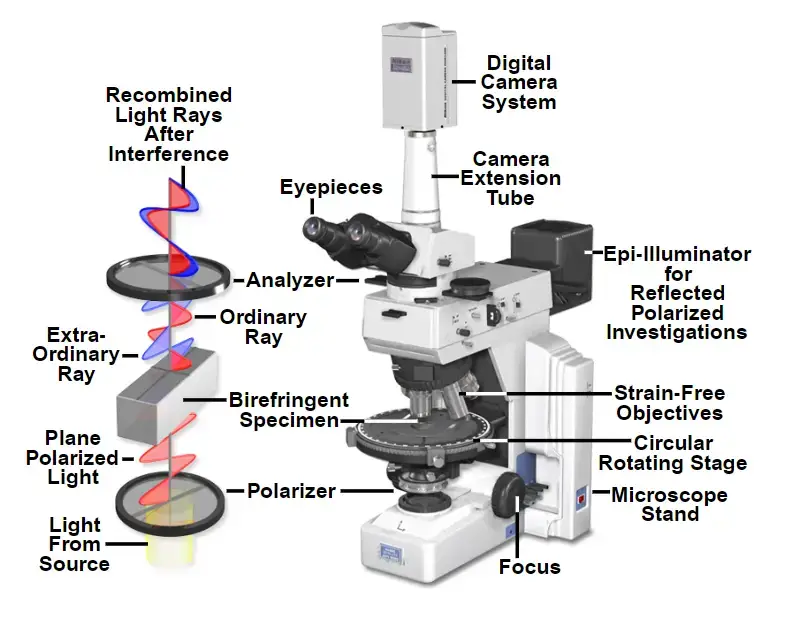
In a polarized light microscope, the source of light and sample are separated by a polarizer. The polarized light source is converted into plane-polarized light before it reaches the sample. The polarized light is passed through a material that demonstrates double refraction. This creates two wave components oriented perpendicular to each other. These two waves are known as common and exceptional light beams.

The waves pass through the specimen in several phases. An analyzer then superimposes these phases by constructive and destructive interference. This leads to the formation of an image with high contrast.

Parts of a Polarized Light Microscope

Major components of a PLM are

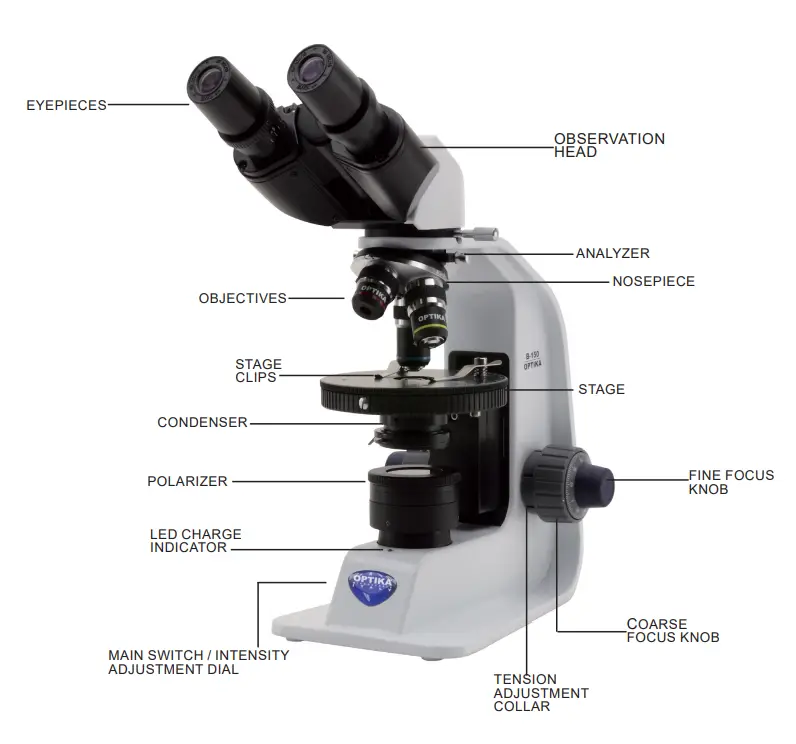
  1. Polarizer. Mounted at the bottom of the specimen stage, a polarizer filters incoming illumination to produce plane polarized illumination. In most cases, its vibration direction is fixed horizontally (East West); however some models allow rotation through 360°.
  2. Analyzer: It is placed above the objective lenses and below the eyepiece. The analyzer is a second polarizing filter that is positioned perpendicular to the polarizer. In this crossed position, only the light altered by the specimen is allowed to pass through to the observer, enhancing contrast and birefringent properties.
  3. Strain-Free Objectives and Condenser: These are optical elements that eliminate internal stresses, which can introduce unwanted birefringence, thus permitting detailed observations of the optical properties of the specimen.
  4. Rotatable circular stage: The stage allows for 360-degree rotation hence enabling the examination of any specimen from different angles under polarized light. Graduated markings allow for the exact measurement of rotational angles that help in the optical properties analysis.
  5. Compensators and Retardation Plates – Compensators and retardation plates are used to manipulate light in the optical path. Inserts, such as full-wave retardation plates, quartz wedges, or quarter-wave plates, can be placed in the light path. These instruments change the phase of light passing through the specimen, increasing contrast and allowing for the determination of optical properties such as birefringence and optical sign.
  6. Bertrand Lens: Also called a phase telescope, it is used to observe interference patterns (conoscopic images) formed by birefringent specimens. It is used in the study of optical indicatrices and optic sign determination.
  7. Coarse and Fine Focus Knobs: These are controls that vary the height of the stage so that the specimen is brought into focus. The coarse focus is used for rapid changes while the fine focus is used for precise control which is important in detailed examination.6
  8. Illumination System: A light source, often with a condenser, will provide even illumination. In polarized light microscopy, the illumination system may be fitted with filters to control intensity and wavelength, enhancing image quality.
  9. Eyepieces (Oculars): The eyepieces are used to magnify the image produced by the objective lenses. Some polarized light microscopes have a pointer or reticle to enable measurement.
Polarizing Microscopes

Operating Procedure of Polarized Light Microscope

Using a Polarized Light Microscope (PLM) requires care and attention in order to produce accurate and reliable observations. This is a simplified guide to aid you:

  1. Turning the Microscope On
    • Switch on the light: Locate the power switch, commonly found on the side or bottom of the microscope, and turn it on.
  2. Preparation of the Specimen
    • Place the specimen slide on the stage: Carefully place your prepared slide on the microscope stage, making sure it is firmly clamped in place.
  3. Illumination
    • Adjust the light intensity to a comfortable viewing level: Use the control lever or dial to adjust the light intensity to a comfortable viewing level.
    • Open the field diaphragm: Ensure the field diaphragm is open to the edge of the field view to provide uniform illumination.
  4. Focusing the Image
    • Focus using coarse and fine adjustments: Use the coarse focus knob to see a general overview of the specimen, and the fine focus knob for small and precise changes. Move the slide to view the entire specimen: Gently move the slide and look at parts of the specimen, focusing where necessary.
  5. Polarization Filters
    • Insert polarizer: Place the polarizer filter in the optical path, usually below the stage, to polarize the light.
    • Set analyzer: Insert the analyzer filter into the optical path, usually above the objective lens, to look at the polarized light that passes through the specimen.
    • Rotate analyzer: Rotate the analyzer to observe the specimen through crossed polarizers, which enhances contrast and reveals birefringent materials.
  6. Changing Objectives
    • Change objectives if needed: Rotate the nosepiece to bring the desired objective lens into position.
    • Refocus and diaphragms: Refocus using the fine adjustment knob and then adjust the field and aperture diaphragms to get maximum contrast and resolution.
  7. Final Adjustments
    • Align properly: Ensure that all optical parts, including polarizer and analyzer, are properly aligned for observations.
    • Record observations: Note your observations with any detail relevant to the specimen’s appearance under polarized light.
How does a Polarized Light Microscope Works?

Applications of Polarized Light Microscope

Polarized Light Microscopy (PLM) is a useful method used in many scientific fields to study materials that have different optical properties. It can be used in:

  • Mineralogy and Geology: PLM is often used to find and describe minerals in rock samples. By looking at the birefringent properties of minerals, geologists can find out their composition and structure.
  • It is applied in forensic investigations, where PLM studies small evidence like fibers, hair, and glass fragments to help match materials found at the crime scene to potential sources.
    Biology and Medicine: Biological tissues and structures are studied through PLM.  This includes studying collagen fibers and muscle tissues to understand how fibers are organized and positioned within tissues.
  • Material Science: It can be used for determining the areas of stress within materials such as metal and glass. From birefringence patterns, one can trace mechanical stresses or strains at particular points.
  • Semiconductor Industry: PLM detects defects within semiconductor materials. It allows one to inspect semiconductor wafers for stress and strain, a very important quality control tool during manufacturing.
  • Environmental Science: PLM helps examine soil samples and identify mineral presence and composition. This helps scientists understand the constituents of the soil and what its structure is compatible with for multiple agricultural uses.

Advantages of Polarized Light Microscope

The advantages of material analysis through Polarized Light Microscopy are as follows:

  • Non-Invasive Analysis: PLM allows one to view the sample without using chemical staining or other preparation methods that can harm the integrity of the specimen.
  • Improved Contrast: The polarized light greatly improves contrast compared to the unaided human eye, thereby helping distinguish one material from another as well as from the various structures in the sample.
  • It identifies crystal structures very well since it is able to recognize birefringence. This is the property that is present in a crystal under polarized light.
  • Rapid Analysis: The technique is fast and also convenient. Hence, it is capable of identifying the salts and the other crystalline products in different samples.
  • Portable Equipment: Basic polarizing microscopes are portable in nature. Such microscopes allow on-site analysis of sensitive materials at different places.

Limitations of Polarized Light Microscope

  • Limited Quantitative Analysis: Standard PLM primarily addresses descriptions, so it is impossible to obtain an exact measurement of birefringent properties. This is because the brightness of light observed varies with the angle of the optic axis of the material to the polarization filters. In biological samples, for example, histological sections, birefringent materials can be oriented at different angles in the sample, making it difficult to quantitatively analyze the sample.
  • Complex Sample Preparation: Certain samples, particularly biological tissues, demand specific preparation methods to enhance birefringence. This would make the analysis more complicated and time-consuming. For example, histological sections could be prepared with birefringent angle-containing materials, making imaging challenging and hard to understand.
  • Special Training Required: The proper use of PLM requires special training in the interpretation of birefringent patterns. This may make it difficult for beginners to learn the technique. The technique is popular among geologists, mineralogists, and chemists, but it takes a lot of training to use it right. This makes it more difficult to enter the field and training takes longer.
  • Only for Birefringent Materials: PLM is practicable for birefringent materials. Isotropic materials, which are not birefringent, do not find any purpose in the case of polarized light. Briefly, the identification of salts by a polarized light microscope along with advantages and disadvantages of the method are explained.
Reference
  1. https://microscopeinternational.com/optika-b-150p-brpl-binocular-led-polarizing-microscope-rechargeable/
  2. https://www.microscope.healthcare.nikon.com/products/polarizing-microscopes
  3. https://www.microscopyu.com/techniques/polarized-light/polarized-light-microscopy
  4. https://www.olympus-lifescience.com/en/microscope-resource/primer/techniques/polarized/configuration/
  5. https://www.azolifesciences.com/article/What-are-Polarized-Light-Microscopes-and-How-Do-They-Work.aspx
  6. https://www.microscopeworld.com/t-polarizing_microscopes.aspxhttps://www.microscope.com/specialty-microscopes/polarizing-microscopes
  7. https://www.sciencedirect.com/topics/chemistry/polarizing-microscopy
  8. https://meijitechno.com/meiji_old/polarizing_applications.htm
  9. https://www.news-medical.net/Life-Science-and-Laboratory/Polarizing-Microscopes
  10. https://zeiss-campus.magnet.fsu.edu/referencelibrary/polarizedlight.html
  11. https://www2.humboldt.edu/scimus/HSC.36-53/Descriptions/AOPolScp.htm
  12. https://www.optikamicroscopes.com/optikamicroscopes/product/pol-series/
  13. https://www.motic.com/As_Polarized_microscope/
  14. https://amscope.com/collections/polarizing-microscopes
Categories
Microscope

How are samples prepared for a transmission electron microscope?

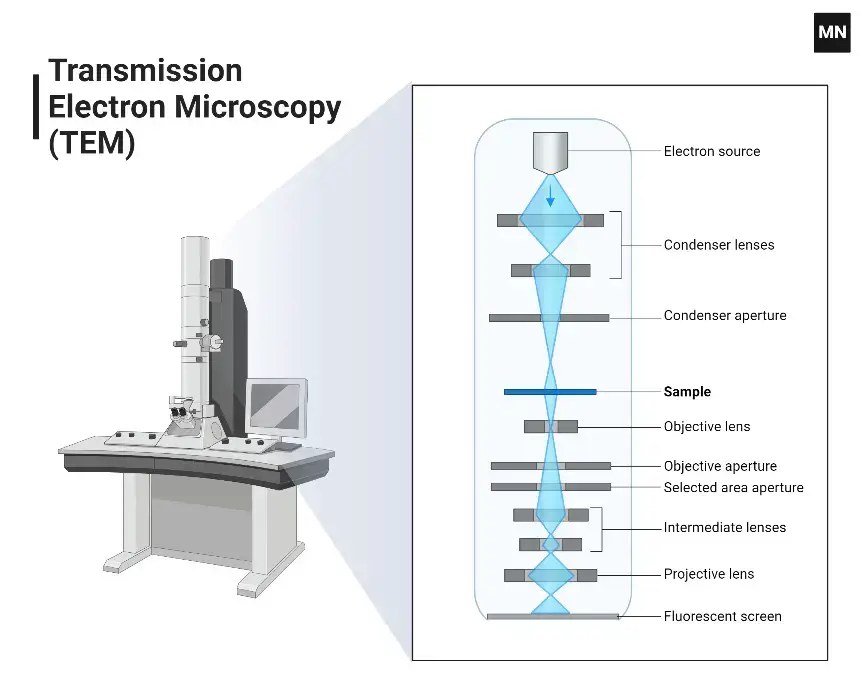
A TEM is an extremely advanced tool that uses a beam of electrons to look at and study the inside structure of thin samples at an extremely high detail. Unlike light microscopes, which use visible light, TEMs use the shorter wavelength of electrons to get magnifications that can be millions of times bigger. Here’s a summary:

  • Working Principle
    • A strong electron beam is directed onto a very thin sample.
    • Electrons interact with the sample as they pass through, forming an image.
    • The transmitted electrons (hence the name) are captured by detectors or a phosphor screen, creating a highly detailed image.
  • Magnification & Resolution
    • TEMs can magnify objects up to 2 million times.
    • Resolutions can reach as fine as 0.1 nanometres, allowing the imaging of atomic structures.
  • Sample Requirements
    • The specimen needs to be extremely thin, often less than 100 nanometres.
    • It also needs to be prepared with great care, sometimes needing staining with heavy metals to improve contrast.
  • Applications
    • It is widely used in material sciences to investigate crystal structures, dislocations, and nanostructures.
    • It is crucial in biology to image organelles, viruses, or molecular complexes.
    • It is used in semiconductor research to investigate thin films and interfaces.
  • Advantages
    • Excellent resolution of internal details.
    • It can be used to determine chemical composition by methods such as energy-dispersive X-ray spectroscopy (EDX).
  • Limitations
    • Costly and needs considerable expertise to operate.
    • Samples have to withstand the vacuum and intense electron beam, which limits their use for some materials. TEMs are among the best tools used in looking at small things; details that the best light microscopes cannot reveal can be found with them.

Why We need to prepare specimen sample for TEM?

Getting a sample ready for TEM is very important to get clear, detailed images. TEM makes use of electrons that go through a very thin sample, and so preparation goes hand in hand with care. This is why:

  • Electron transparency-TEM samples need to be very thin, normally less than 100 nm, to allow the passage of electrons without excessive scattering. In any other case, the electron beam would not go through well, and the images attained would be poor or unusable.
  • Artefact minimization – Careful preparation helps minimize artefacts that might distort imaging, meaning the appearance of the material reflects its inherent structure. Such artefacts might be caused by cutting or even polishing, blurring details and producing misleading structures.
  • Contrast enhancement – biological or organic samples typically don’t have sufficient contrast naturally to scatter the electrons. Contrast enhancing techniques include staining with heavy metals or embedding samples in resins. Thus, the sample may be visible in the resulting image.
  • Alignment of the Sample – the orientation of the sample ensures that the important features are visible and properly aligned in the path of the electron beam. This is particularly important with crystal materials and biological large molecules.
  • Avoid contamination – Samples not prepared correctly could become contaminated (through dust, moisture, or fingerprints) which would change the results or ruin a sensitive instrument. Keeping everything clean maintains the accuracy of analysis.
  • Preservation of the sample – TEM operates in a vacuum. The vacuum could dry out and even degrade some samples. Preparation techniques, such as cryofixation, preserve the sample state when viewed using TEM.

Sample preparation Procedure for TEM

In this method, the particle under observation is bombarded with electron beams in a transmission electron microscope, and the produced images are processed through computers.

One of the critical steps of TEM is sample preparation, and the way in which the sample is prepared is based on what the material is and what information is needed.

Specimens for TEM preparation are carried out in the following steps:

  1. Fixation
    Fixation of the specimen stabilizes the cell, which would otherwise be changed or damaged by any further procedure. This technique fixes the sample to give a snapshot in time of the living cell. Fixation can be done by the following two methods:
  2. Chemical fixation: Chemical fixing is a method by which biological samples are stabilized. Chemical chemicals are used to cross-link protein molecules with adjacent molecules. Glutaraldehyde is the most common chemical used for this process.
  3. Cryofixation: This method demands the rapid freezing of the specimen in liquid nitrogen or liquid helium. Thus, the sample’s water content gets converted into some sort of vitreous ice.
  4. Washing
    Tissue fixing may make the specimen more acidic. This can be avoided and the pH level maintained constant by rinsing it very carefully with a buffer such as sodium cacodylate.
  5. Secondary fixation
    Osmium tetroxide highlights the minute details of the specimen and stabilizes as well. OsO4 converts proteins to gels; it increases contrast between neighboring cytoplasm due to binding towards parts of the phospholipid heads without changing its properties.
  6. Dehydration
    This involves substitution of the solvent present in the sample with the organic solvent. A few good options for organic solvents include ethanol and acetone. It is an essential process as the water can be used by the epoxy resin applied next which will not dissolve in the latter.
  7. Infiltration
    In infiltration, epoxy resin is added to the cell to fill up the space, and the sample becomes strong enough to handle pressure in cutting. This method is also known as embedding. The resin is left overnight in a 60-degree oven to harden. This process is called polymerization.
  8. Polishing
    Some of the materials, after embedding, are polished. Polishing a specimen reduces scratches and other problems that can lower the image’s quality. The specimen is polished with very fine abrasives to make a shiny surface.
  9. Cutting
    The sample is semi-transparent to be seen under an electron microscope; thus, the beams of electrons can pass through it. To cut the sample into thin slices, it is sliced with a glass or diamond knife attached to a specific tool known as an ultramicrotome. This particular tool has a container filled with pure water. These slices are assembled inside this container prior to being transported to a copper grid for scrutiny using a microscope. To properly view details clearly, each section should be between 30 and 60 nanometers.
  10. Staining
    Biological samples are usually stained twice before drying and cutting. Heavy metals such as uranium, lead, or tungsten are used for this purpose so that the different parts of the sample are differentiated to scatter the electron beams. A block form staining is done in the case of the sample before drying, while after cutting it is briefly dipped in a watery solution of these metals. Such a sample is likely to skip most of the above treatments as it can simply be cut into small pieces followed by coating the sections with platinum, gold or carbon vapors for TEM observation. Besides general preparation steps taken before TEM viewing, there is still other treatment one can utilize:
    • Ion-mining: In this technique, the sample is thinned by shooting charged argon ions at its surface until it becomes clear enough to see through. The process of focused ion mining uses gallium ions for thinning.
    • Cross-sectional method: This technique is used primarily to examine interfaces.
    • Replica technique: This is used only when the primary specimen used to prepare thin sections cannot be destroyed.
    • Electrolytic polishing: It is a method used to get thin samples of metal or an alloy. Here, various techniques such as coring, rolling, grinding, and peeling are used.

Conventional Method For preparation of ultrastructure

The following is a general procedure for preparing samples for ultrastructure imaging.

  1. Attach first to aldehydes (proteins)
    In this phase, the molecules of the fixative crosslink proteins together and to a lesser extent other structures within the cell. For smaller mammals, fixation can be accomplished by perfusion, where the fixative is directly infused into the circulating system of the animal. For other samples, the specimen will be treated by immersion, and then cut in at least one direction down to no more than 1 mm.
  2. Secondary fixation with osmium tetroxide (lipids)
    This ensures that the lipids, for example, the phospholipids forming the membranes, are not lost in the drying process. In this fixing step, there is formation of black, solid material on the membranes, which provides positive contrast.
  3. Final fixing and contrasting with uranyl acetate
    Uranyl acetate is a heavy metal salt, that is, it creates additional contrast by binding to proteins, lipids, and nucleic acids. Some authors also claim it has fixative properties. The samples can be incubated in a solution of uranyl acetate before dehydration or the stain can be applied to sectioned specimens before lead staining.
  4. Solvent dehydration series ethanol or acetone
    A specimen is dehydrated by placing it in different solutions of ethanol or acetone. The amount of solvent is slowly increased to remove water without causing damage, mainly by shrinking.
  5. Adding and covering with resin
    Once the specimens are dehydrated, even more liquid resin replaces the solvent, usually epoxy resin when ultrastructure is to be studied. The sample is then placed in a mold of liquid resin, which undergoes hardening from heat or UV light. Samples can last forever.
  6. Cutting and mounting sections on specimen grids
    The pieces can be so thin that a sample in hard resin can be divided into pieces thinner than 100 micrometres. The electron beam is passed through from the electron gun to the detector. The pieces are put on grids that fit into the microscope’s sample holder.
  7. Contrasting (poststaining)
    The atoms have low atomic numbers; thus, the biological specimens are not very electron-opaque. This means the electron beam can easily pass through them. Sections can then be stained with lead citrate to make the contrast better. This heavy metal salt adheres to cell parts like osmium tetroxide and uranyl acetate, scattering the electrons from the beam. The parts of the specimen section, which scatter more electrons, come out darker relative to a lighter background when using darker pixels.
Categories
Microscope

Light Microscope – Labeled Diagram, Definition, Principle, Types, Parts, Applications

The light microscope is a very useful tool in the field of science. That kind of tool that, even though it seems easy, lets us see a whole new world. Using visible light to magnify small objects, this microscope lets us peer into realms far beyond what our eyes can naturally see. We would not know anything about the inside workings of cells, organs, and all the other tiny living things that make up life itself without it.

So how does it work? Light microscopes have an eyepiece and several objective lenses that focus light on or off of a sample. When light goes through the material, these lenses work together to make a bigger picture of the thing being studied. That’s pretty smart, right? The lenses change the shape of the light so that you can see things like bacteria or the very small parts inside cells up close.

But don’t fall for it! Even though they can be used for many things, light lenses have their limits. At higher magnifications, features become less clear because the resolution is tied to the light wavelength. This means that they can’t be used to look at viruses or atoms up close. Still, they can make things up to 1000 times bigger, which is plenty to look at a lot of different living samples.

They’re very attractive because they’re not too expensive and are simple to use. You can find these microscopes everywhere, from a high school biology class to a state-of-the-art study center. Being able to look through a glass and see a whole new world is a thrilling experience that everyone has had. There are bacteria moving around, cells dividing, and sometimes an amoeba doing its thing. It’s like going into a whole new world!

But, of course, like most telescopes, there’s a catch. It’s not enough to just put a sample under the lens and expect great results. Preparation is very important. You need thin slices, the right stain, and a steady hand to place the slide. You know what I mean if you’ve ever had a hard time changing your focus for a long time!

The light microscope is indeed a useful tool. Even though it’s not as powerful as an electron microscope, it’s good enough for everyday studies of live things. The light microscope is an important and reliable tool for scientists of all levels, from college students getting ready for a practice to biology teachers showing students the wonders of the subject.

And in the big picture, it shows that science doesn’t have to be high-tech all the time to be great. A little light and a good set of lenses are sometimes all you need.

What is a light microscope?

A light microscope is an optical microscope, utilizing visible light that magnifies very tiny objects. This equipment works by allowing the passage of light through or reflection off a particular object, and lenses collect this light to create a magnified view. Light microscopes are very commonly used in labs for the general examination of cells, tissues, and other microscopic features.

  • Basically, it relies on visible light, so one sees the sample without depending on sophisticated technology.
  • Light microscopes are equipped with various lenses; however, the most prevalent among these are the eyepiece and objective lenses, which offer distinct levels of magnification.
  • They may not be of the highest magnification but, being versatile, are applied in a wide scope of biological, medical, and scientific research.
  • The standard light microscope can magnify objects to about 1000x. It is not enough to see viruses or smaller molecules, but it gets the job done for cells and bacteria.
  • It is determined by the wavelength of light; hence, finer details are difficult to discern at high magnifications. Nevertheless, it remains very effective in viewing the general structure of organisms, tissues, and cells.

Principle of a light microscope (optical microscope)

The principle of a light microscope, also known as an optical microscope, is essentially founded on the behavior of light while it travels through different media. An important concept here is refraction, which is the bending of light when it passes from one substance to another and therefore changes direction. This bending depends on the refractive index of the materials, which in turn quantifies how much a material resists the propagation of light.

When light travels from one medium to another, its velocity changes, which results in bending. For example, when light is traveling from glass to air, it speeds up and bends away from the normal. On the other hand, when light is traveling from air into glass, it slows down and bends toward the normal. The principle of refraction makes lenses in microscopes work as it dictates how light is focused.

A conventional lens in a light microscope is convex, meaning that it is meant to refract light rays towards some point called the focal point. The distance from the focal point to the center of the lens is termed as the focal length. Such lenses have an image magnified more when their focal length is smaller because the light is focused more accurately. This is the reason why in microscopes, short focal length lenses are commonly used for increasing magnification.

The power of the lens decides the magnification of the light microscope. But it is inversely proportional to the focal length. Therefore, magnification alone cannot decide the ability to resolve small details. Now, let us discuss the term resolution-the ability of a microscope to distinguish between two closely spaced objects. This is a resolution that depends on the numerical aperture of the lens as well as the wavelength of light used.

The numerical aperture is a measure of how much light a lens can capture. This is determined by both the lens design and the refractive index of the medium in which the lens and specimen reside. Meanwhile, the wavelength of light determines the resolving power of the microscope. The lower the wavelength, the higher is the resolution. The relationship between the wavelength and the numerical aperture is quantitatively expressed by the Abbe equation, which allows one to calculate the minimum distance (d) at which two points can still be perceived as separate entities. The equation is:

d=0.5λ​/nsinθ

In this case, λ is referred to as the wavelength of light, n stands for the refractive index and θ represents the angular aperture of the lens system.

The limitation in practice, of course, is that objects can only be resolved down to a certain limit with a light microscope, around 200 nanometres due to the limitation imposed by the wavelength of visible light. Nevertheless, light microscopes are one of the most useful tools for biologists and others, giving them a view of structures and organisms at a cellular level.

Types of light microscopes (optical microscope)

Light microscopes, which are also called optical microscopes, are often used to make things bigger by using light. Every type is used for a different thing and has its own special qualities.

Phase-contrast Microscope
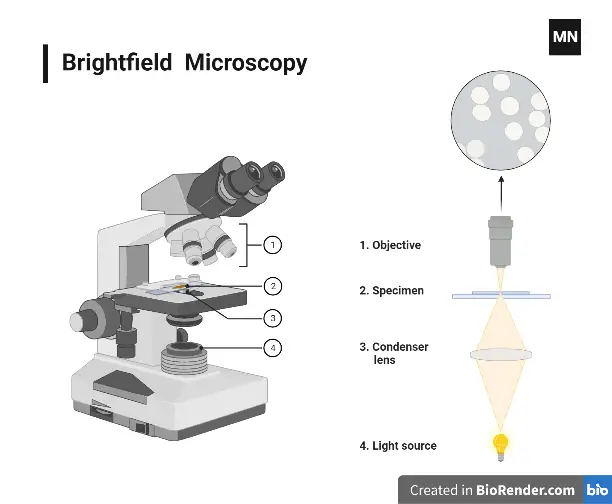
  • Brightfield Microscopes – Brightfield light microscopes are most frequent. The filters focus the light that goes through the specimen. It’s often used to look at specimens that are stained or naturally colored.
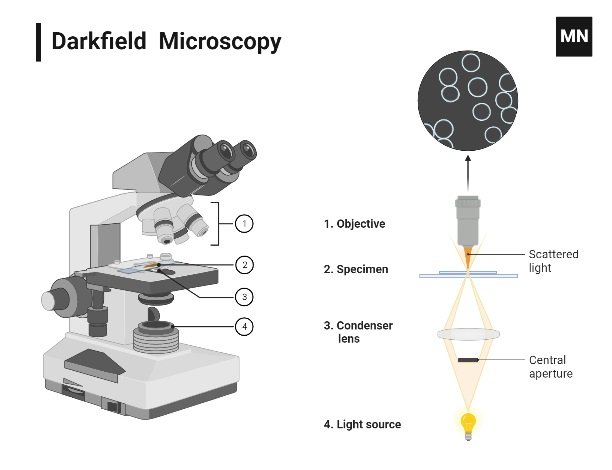
  • Darkfield microscopes– These let you see things that you can’t see with a brightfield microscope. A special lens called a condenser lens bends the light in a way that makes the object stand out against the dark background.
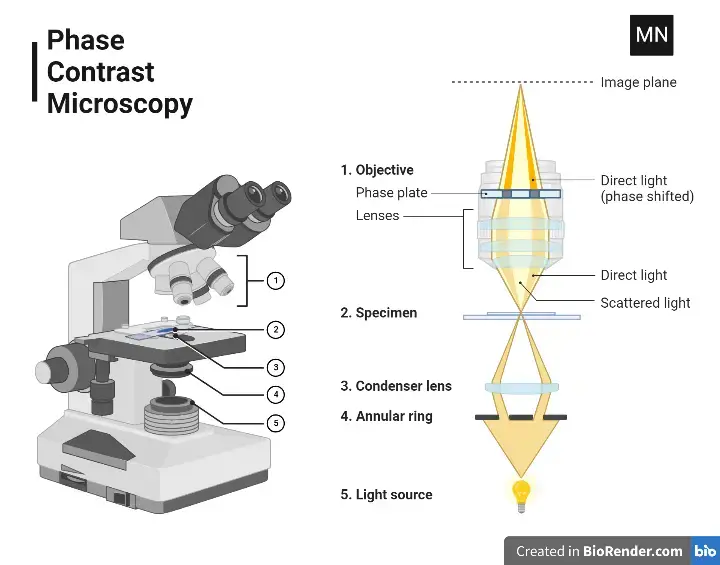
  • Phase-contrast microscopes– Phase-contrast microscopes are helpful for studying living cells because they improve contrast without requiring staining. This kind of microscope makes the changes in the refractive indices of different parts of cells stand out more.
  • Differential Interference Contrast (DIC) – Used for thick or live specimens. The pictures it gives look like they are in 3D, and surface details stand out. It gives unstained objects more contrast and is sometimes called Nomarski interference.
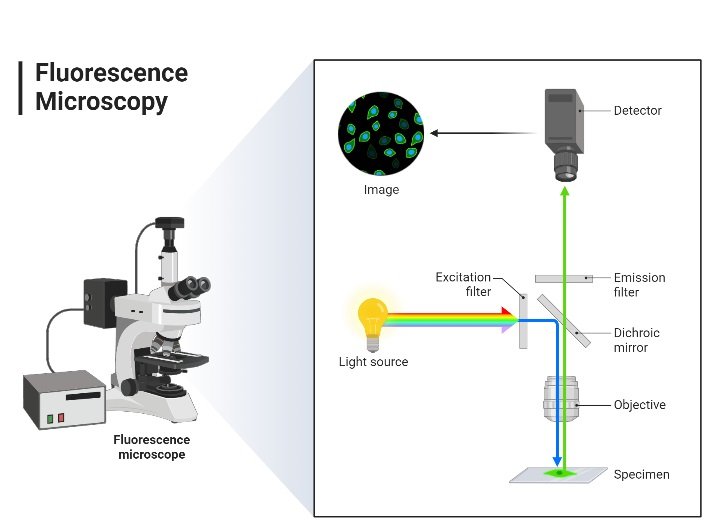
  • Fluorescence Microscopes – The fluorescence microscope works by exposing the sample to high-energy light, which stimulates the sample’s fluorophores, causing them to release light with a distinct wavelength. It’s used a lot in biological studies to mark and keep track of certain structures or proteins.
  • Confocal Microscopes – Confocal microscopes use laser light to scan specimens and provide high-resolution images at varying depths. Optical sections made possible by confocal microscopy make it easier to look at thick material.
  • Stereomicroscopes (Dissecting Microscopes) – Stereomicroscopes, also called “Dissecting Microscopes,” are different from other types of microscopes because they have low magnification, usually 10x to 40x. It’s great for seeing bigger things in three dimensions, like flowers or bugs.
  • Polarizing microscopes– Geology and materials science are the main fields that use these. Polarized light is used by the microscope to make the contrast of clear objects or minerals stronger, which shows details that were previously hidden.
  • Tandem Microscopes: Several different kinds of microscopes are sometimes put together in one setup. These are often found in high-tech study labs that use a lot of different observation methods to do complex analysis.
  • Digital Microscopes: These microscopes have cameras that make it easy to take pictures and look at them on a computer screen. They might use both light and other image methods, such as fluorescence.
Dark-Field Microscope
Fluorescent Microscope

Parts of a Light Microscope

  • Eyepiece – This is the lens you look through. It usually makes things 10 times bigger, but it can be different. It’s sometimes called the ocular lens.
  • Objective lenses – These are the lenses that are nearest to the specimen. They have different powers to make things bigger, usually 4 times, 10 times, 40 times, and sometimes 100 times. These lenses let you zoom in on your specimen.
  • Revolving nosepiece – It is a circular part that carries the objective lenses. You can turn it for lens change to change magnification easily.
  • Stage – This is the flat part on which you place your slide. The stage often has clips that hold your slide in position.
  • Coarse adjustment knob – A large knob that moves the stage up and down to help focus the specimen when using low magnification. It is used for general focusing.
  • Fine adjustment knob – A small knob that is used after the coarse adjustment, helps to make the focus clearer for better detail.
  • Condenser – A lens that directs light onto the specimen. Some microscopes have a diaphragm to adjust how much light goes through.
  • Illuminator: The source of light, which can be fitted into the microscope or attached as a separate. It usually illuminates the specimen from below.
  • Arm: This is the connection between the eyepiece and the body of the microscope and the base. It is for carrying the microscope safely.
  • Base: The lower part that holds the whole microscope. It’s usually heavy in order to hold the instrument stable.
  • Diaphragm – A disk with holes that controls how much light gets to the specimen. It helps make the image clearer and easier to see.
  • Mechanical Stage – In some models, this is a tool that moves the slide left and right and up and down for better control when looking at the specimen.
Light Microscope Labeled Diagram

Operating Procedure of Light Microscope

Operating a light microscope requires caution in handling the process to ensure accurate observation without damaging the sample or the instrument. The steps involved in using the light microscope are shown below.

  • Prepare the workspace: Always clean the working space before setting up the microscope. Ensure the microscope is situated on a steady, firm base and not near dust or things that may be distracting. See to it that there is available power and then adjust the lights if necessary.
  • Inspect the microscope assembly – Ensure that the objective lenses are tightened in and that the eyepiece is properly installed on the microscope. Check if the illuminator works and light intensity is controllable.
  • Prepare the specimen. Mount the specimen on a clean slide for viewing under the microscope. Color or fix the sample if necessary to do so. It can also be covered by using a cover slip for its protection and to prevent movement during microscopic viewing. Prepare the specimen by getting the living organism ready to look at.
  • Place the slide on the stage-Place the prepared slide on the microscope’s stage. Lock it using the stage clips so that it does not move from the place. Keep the slide centered under the objective lens to avoid missing some parts of the sample.
  • Adjust the diaphragm and light source – Switch the diaphragm to regulate the amount of light that hits the sample. Start with minimal light and alter it if necessary. The condenser must be aligned to send light to the specimen for clearer viewing.
  • Choose the objective lens – Start with the lowest magnification lens, usually 4x or 10x. This helps you see a wider view of the sample before looking closer for more detail. Turn the revolving nosepiece to change to the right lens.
  • Use the coarse adjustment knob – Begin focusing by turning the coarse adjustment knob. This raises or lowers the stage to make the specimen approximately clear. Do not force the knob too much – turn it slowly to avoid damaging the lens or sample.
  • Use the fine adjustment knob to make your specimen sharper and clearer. When the specimen is nearly in focus, you use a fine adjustment knob for it to become even sharper and clearer. You can get the details of the specimen without moving the stage too much.
  • Change the focus when using higher magnifications: If you wish to use a higher magnification (such as 40x or 100x), make a new adjustment on the fine focus. At these higher magnifications, a small depth of field is generally present, and higher magnifications generally require more sensitive focusing.
  • Observe the specimen- After focusing the specimen, examine its details. Identify cellular structures, organelles, or other features of interest. Make appropriate adjustments in the light intensity or diaphragm to improve contrast and resolution.
  • Move the slide, if necessary- You will be able to see all the different parts of the specimen if you move the slide. Use your model’s mechanical stage controls to move the slide in order to see your sample moving smoothly and under controlled motion beneath the lens.
  • Turn off the microscope when finished – After completing your observation, turn off the light source and lower the stage. Remove the slide from the stage carefully. Turn off the microscope and clean any lenses if necessary.
  • Clean the lenses – If the lenses are dirty, use a lens paper to clean them lightly. Avoid using any harsh material that may scratch the lenses. Cover the microscope when not in use to protect it from dust.

Advantages of Light Microscope

  • User-friendly – Light microscopes are easier to operate than an electron microscope. They actually allow beginners to use them effectively.
  • Cost-effective – Light microscopes are more affordable compared to electron microscopes. This makes them accessible to education institutions and labs.
  • Requires less intense preparation: Sample preparation needed for light microscopes is minimal, thus a specimen can be seen in its original form.
  • Viewing live specimens: The specimens that are alive can be observed directly in a light microscope but dead specimens must be used for the electron microscope.
  • Applications: In medicine, biology, and material science, the light microscope can clearly produce images of cells, bacteria, and minerals.
    Non-destructive: Since it does not emit harmful radiation, specimens may be preserved for repeated observations.
  • Portable – Light microscopes are portable and lightweight. This makes it easy to carry them around in the field, unlike the more cumbersome equipment.
  • Low maintenance – Because light microscopes have fewer parts, they require very little maintenance, mostly just lens cleaning and checking alignment.
  • Quick imaging – It takes a shorter time to take an image, unlike the time-consuming process of electron microscopy.
  • Flexible magnification – Light microscopes have a set of objective lenses to provide different magnifications for both high and low resolution.

Limitations of Light Microscope

  • Light microscopes can only discern objects down to 200 nanometres due to visible light wavelength. This makes it difficult to see molecules or viruses.
  • Even with the highest-powered objective lens, light microscopes cannot magnify specimens beyond 1000x to 2000x, making them unsuitable for studying ultra-small organisms or cell structures.
  • Light microscopes’ limited depth of field makes focusing on thick specimens challenging. Electron microscopes have a deeper field for thicker materials.
  • Higher magnification reduces resolution, making it harder to capture a clear image of the specimen, especially in poorly prepared or discolored samples.
  • Light microscopes may not provide enough contrast for clear cells or tissue. While staining can help, it may not solve the issue.
  • You can see multiple specimens, but they must be tiny enough to fit under the microscope. This restricts cellular and below-cellular research.
  • Proper lighting is essential for microscope performance. The image will be dark and lose details without proper lighting.
  • Light microscopes can see exterior characteristics and some inside structures, but they can’t see organelles or internal structures in depth without additional preparation.
  • Light microscopes can see live specimens, however some staining methods can be poisonous or change the specimen’s structure, impairing the observation.
  • In labs with many units, light microscopes take up room despite being smaller than other advanced imaging instruments. They may not be as small as handhelds.

Uses of Light Microscope

  • Biological research – Light microscopes are significantly important for examining cells, tissues, and microorganisms, like bacteria, fungi, and plant cells, for understanding the cell structure.
  • Medical diagnosis – In medical science, pathologists make use of the light microscope for examining tissue samples, such as a biopsy, in order to determine diseases like cancer or infections.
  • Microbiology – Light microscopes in the microbiology laboratory help observe bacteria, viruses indirectly, and algae, aiding in species identification and tracking antibiotic or environmental effects.
  • Histology – Light microscopes are essential for studying tissue structure by examining thin, specially prepared, and stained slices of biological tissue.
  • Botany– Using light microscopes in botany allows one to view the different types of cells, tissues, and structures like leaves, stems, and flowers. Researchers may then view how the cells are arranged in such structures as well as their features in the different organs.
  • Education– Light microscopes are generally used in schools for teaching cellular biology, genetics, and microbiology by direct specimen observation.
  • Forensic science – Forensic analysts use light microscopes to study samples of hair, fibers, and particles found in crime scenes in order to assist in suspect identification and the overall understanding of crime.
  • Pharmaceutical research – Light microscopes enable scientists to see cell or bacterial reactions to drugs, which will help them understand the effects before clinical trials.
  • Environmental science – Light microscopes examine pollutants and microorganisms in water or soil, helping scientists monitor ecosystem health and detect harmful algal blooms.
  • Material science: Researchers use light microscopes in the study of materials’ microstructures, which would help to understand properties, flaws, and applications.
  • Quality Control in Manufacturing Quality control checks the products microscopically across industries. Raw material purity is checked, which includes a check on finished product integrity and manufacturing standards.

Light Microscope Free Worksheet

Light Microscope Free Worksheet
Reference
    Categories
    Microscope

    Inverted Microscope- Definition, Principle, Parts, Labeled Diagram, Uses, Worksheet

    An inverted microscope is a special type of microscope. It doesn’t resemble other regular microscopes, as the light source and condenser point upward to shine directly downwards onto the specimen stage. The objective lenses, along with the turret, face up from below the stage. In other regular upright microscopes, the stages have objectives facing up while the light source is pointing down. It was invented by J. Lawrence Smith in 1850 at the Medical College of Louisiana, which is now Tulane University. In general, an inverted microscope has a fixed stage to hold bigger sample containers, like Petri dishes or tissue culture flasks, so it can better observe living cells or organisms under more ideal conditions.

    Focus adjustment is achieved by moving the objective lenses along a vertical axis to bring them closer to or farther from the specimen, utilizing dual concentric knobs for coarse and fine adjustments. A rotating turret, or nosepiece, holds multiple objective lenses of varying magnifications, allowing for versatility in viewing. In addition, cameras for photomicrography and movie-making, fluorescence illumination, and confocal scanning units can be added to inverted microscopes to improve their operation. There are several advantages of inverted microscopes. The primary advantage of inverted microscopes is that a person can observe living cells or organisms placed at the bottom of large containers, like tissue culture flasks, without having to move the sample onto a glass slide. This feature is very useful in cell biology and microbiology, where the maintenance of the original environment of the specimen is highly critical.

    Inverted microscopes are also used in micromanipulation procedures, providing enough space above the specimen for tools and equipment. In metallurgy, they help to observe polished specimens mounted on the stage, which can be observed from below through specific lenses.

    Principle of the Inverted Microscope

    Like a normal light microscope, an inverted microscope works by using the same basic ideas. In order to generate an image that can be viewed by the objective lenses, they employ light rays to focus on a specimen. However, in the inverted microscope, the light source and condenser are located on top of the stage, looking downwards. The primary function of the condenser lens located above the specimen stage is to focus the light on the specimen. The sample is put on a big stage that can hold it. The objectives, which are placed below the stage and pointed upwards, collect light from the condenser, magnifying the image before sending it to the ocular lens. The ocular lens reflects light through a mirror. With the help of an ibidi Polymer Coverslip and an ibidi Glass coverslip, the cells can be seen and studied through the bottom part of the cell culture device, which has total optical points.

    Parts of the Inverted Microscope

    The main parts of an inverted microscope include:

    • Light Source: This is the source of light to the specimen. In an inverted microscope, the light source is above the stage and shines down on the specimen.
    • Condenser Lens: This focuses light on the specimen. It is located above the stage and collects light from the source to shine on the specimen, thus making it brighter and clearer.
    • Stage: Stabilizes the specimen. It is generally bigger and remains stationary, designed to hold several sample containers such as Petri dishes or culture flasks.
    • Objective Lenses: Magnify the specimen. These are positioned underneath the stage, which they face upwards, hence capturing and enlarging the view of the specimen. A few objectives vary in magnification and are fixed to a rotating nosepiece.
    • Nosepiece (Turret): It carries and rotates the objective lenses. Different magnifications can be selected by rotating the desired objective to its position.
    • Focus Adjustment Knobs: Fine focusing is done using the knobs. Dual concentric knobs, which have coarse and fine adjustments, move the objective lenses vertically for getting the exact focus on the specimen.
    • Eyepieces (Ocular Lenses): These are used to observe the magnified image. They are placed at the top of the microscope and further magnify the image formed by the objective lenses.
    • Illumination Control: It controls the intensity of light. Diaphragms and filters control the amount and quality of light reaching the specimen to enhance contrast and clarity of the image.
    Inverted Fluorescent Microscope
    Inverted Fluorescent Microscope

    Uses of the Inverted Microscope

    • Living Cell Imaging: Inverted microscopes are suitable for natural cell observation. They let scientists study cells in growth dishes without touching them, which makes it easier to see how cells are working in real time.
    • Industrial Applications: To analyze huge or heavy samples that upright microscopes cannot handle, inverted microscopes are utilized in industrial settings. They provide below-the-surface inspection of metallurgical samples, electronic components, and other materials, allowing sample examination flexibility.
    • Micromanipulation: Inverted microscopes are well-suited for micromanipulation techniques due to their ample space above the stage. This includes techniques like in-vitro fertilization (IVF), which need to carefully change cells or embryos.
    • Time-Lapse Imaging: Inverted microscopes enable researchers to observe dynamic processes in living cells over extended periods, thereby facilitating time-lapse studies. This is key to understanding cell development, division, and stimulus response.
    • Material Science: Inverted microscopes inspect surfaces, detect faults, and investigate metal and alloy microstructures. Their configuration enables the investigation of samples that are difficult to see with ordinary upright microscopes.

    Advantages of Inverted Microscope

    • Living Cell Observation: Inverted microscopes let researchers see living cells without pretreatment. This is useful in cell culture experiments when cells stick to culture containers.
    • Larger Samples: Inverted microscopes can examine larger and heavier samples than upright microscopes. Industrial applications with tall or bulky samples benefit from this.
    • Enhanced Sterility: Objective lenses are below the stage, so they don’t touch the sample. This arrangement prevents contamination during live cell imaging by maintaining sterility.
    • Easy Sample Access: The inverted structure allows access to the sample from above, making medium exchange and micropipetting easier.
    • Avoiding Objective Damage: By placing the objectives underneath the level, sample manipulation can be done without accidently destroying them.
    • Time Efficiency: Inverted microscopes provide faster sample changes and adjustments because the specimen does not need to be repositioned. This efficiency benefits research and industry.

    Limitations of Inverted Microscope

    • Limited Magnification – An inverted microscope may not be able to obtain the extraordinarily high magnifications that specialized upright or electron microscopes can provide, yet being appropriate for a wide range of biological and industrial applications.
    • Limited Field of View- They frequently have a lower field of view than upright microscopes, which might make it difficult to study larger objects.
    • Sample Size – These microscopes are for thin, flat, or liquid samples. Bulky specimens may not fit or block objective lens focus.
    • Restrictions on technique flexibility- Some sophisticated imaging techniques, such as polarized light microscopy, might not work as well with an inverted microscope’s architecture.
    • Price— Inverted microscopes cost more than upright ones due to their unique shape.
    • Inconvenience in Specific Uses – When working with opaque samples, the illumination may not be as effective because it originates from below the stage.
    • Maintenance—The complicated optical structure, including lenses below the stage, makes cleaning and maintenance harder.
    • Ergonomic Challenges- Despite being designed for ease of use, their design may nonetheless cause uncomfortable positions after extended use.
    • Not beginner-friendly– Upright microscopes are frequently easier to use, making them ideal for instructional and beginning applications.

    Inverted Fluorescent Microscope worksheet

    Inverted Fluorescent Microscope worksheet
    Inverted Fluorescent Microscope worksheet
    Reference
    1. Wei, H., Chen, J., Wang, S., Fu, F., Zhu, X., Wu, C., Liu, Z., Zhong, G., & Lin, J. (2019). A Nanodrug Consisting Of Doxorubicin And Exosome Derived From Mesenchymal Stem Cells For Osteosarcoma Treatment In Vitro. International journal of nanomedicine, 14, 8603–8610. https://doi.org/10.2147/IJN.S218988
    2. Sun, Y., Wang, D., Ma, Y., Guan, H., Liang, H., & Zhao, X. (2019). Elucidating Escherichia Coli O157:H7 Colonization and Internalization in Cucumbers Using an Inverted Fluorescence Microscope and Hyperspectral Microscopy. Microorganisms, 7(11), 499.
    3. https://doi.org/10.3390/microorganisms7110499https://conductscience.com/lab/inverted-fluorescent-microscope/
    Categories
    Microscope

    Digital Microscope – Principle, Parts, Application, Advantages

    A digital microscope is a brilliant optical innovation, fundamentally distinguished from a normal microscope simply because it does not employ any eyepiece. The digital microscope uses a digital camera as its image detector and projects the images onto a computer monitor or screen. The entire process eliminates human interaction with the optical system; all the processes of viewing images are done electrically.

    While a traditional microscope demands an external light source that would have to traverse through the eyepiece, a digital microscope usually contains an LED system itself for light. The very format of the digital microscope offers certain inbuilt advantages. For example, while several digital microscopes are USB digital microscopes, they still harbor advanced features like macro lenses and webcams. Higher models have specific illuminations such as Kohler and phase-contrast systems that improve the resolution and contrast of images to a considerable extent. They are primarily utilized in industries and by professionals.

    The first digital microscope was invented in 1986 by Hirox Co. LTD, which was located in Tokyo, Japan. It consisted of a control box attached to the camera along with a lens that marked the beginning of computerized microscopy. Digital microscopes were to undergo great transformations with time. In 2005, a newer version was developed with an inbuilt monitor and computer that did away with the use of an external device. The new design made the device even more compact and easier to use. By 2015, digital microscopes had evolved into devices with USB connectivity to external computers, which increased processing speed but reduced the number of cumbersome cables.

    Digital microscopes are equipped with advanced software intended to process and enhance images. It includes functions such as adjusting brightness, contrast, scaling, and cropping to focus on specific areas of interest. These features are quite essential, making digital microscopes very useful tools in educational and professional settings where high-quality, detailed imaging is of utmost importance.

    Principle of a Digital Microscope

    Digital Microscopes have hardware and software tools that enable the function of focusing and extracting an image from a specimen. The specimen’s image may be captured with the installation of software; whatever can be captured from the specimen appears on the computer monitor screen. These captured images might appear as static pictures in some cases, while others appear like motion videos. They can also be recorded, edited, cropped, labeled, and saved. The software can also be used for measuring the image sizes, magnifying, and modification the image in several ways.

    Parts of a Digital Microscope

    • Hardware Components- Its comprised of the analogue section which includes a light source, traditional microscope structure and cam that substitutes for conventional eyepiece to display specimen images on computer screens.
    • Software section– The programme includes organised units such as viewer component, brightness modifier, image contrast section and histogram equalisation capability to process visuals based on user preferences.
    • Image Processing capability – Like most microscopes, it employs grayscale transformation equation (Jo = Ji + C) where Jo represents output visual, Ji shows input image whilst C indicates brightness adjustment constant.
    • Viewer unit –This component continuously displays specimens and captures images from scope which are then stored and processed according to operator requirements.
    • Brightness control– The unit enhances image illumination depending on light focused on specimen, it controls pixel intensity through positive or negative C values.
    • Image scaling capability – They process and modify specimen dimensions whilst maintaining structural integrity of the visual data.
    • Cropping function– Its designed to remove unwanted sections from captured images whilst preserving essential specimen details for analysis.
    • Processing software– Contains specialised drivers and image manipulation programmes that work together to create high-quality specimen visuals.
    • Display mechanism– The cam focuses specimen image which then appears on computer monitor where its stored and can undergo further processing depending on requirements.
    • Light source placement –The illumination component position varies based on microscope type, with some having it beneath stage whilst others place it above.
    • Camera integration– Most digital scopes utilise removable cams connected via C-mount adapter, though some models feature permanent USB connections.
    • Monitor interface– These instruments connect to computer displays which serve as both viewing and control mechanisms for specimen analysis.
    • Image storage– Its capable of preserving vast quantities of specimen data through sophisticated recording and storage mechanisms.
    • Processing units– The software contains multiple specialised sections that work together to enhance and modify captured specimen images.
    Parts of a Digital Microscope
    Parts of a Digital Microscope

    Types of Digital Microscopes

    1. Biological Digital microscopes – Its contains high magnification capabilities with light source beneath mechanical stage, providing 4x-100x objective with halogen or LED illumination for detailed specimen analysis.
    2. fluorescence Digital Microscopes– Like most microscopes, these optical devices utilise fluorescence and phosphorescence light sources to generate specimen images.
    3. inverted digital scope– The instrument contains light source and condenser positioned atop stage whilst objectives remain below for specialised examination through trinocular design.
    4. Metallurgical Digital Microscopes – Its specifically designed to examine metallic surfaces, wire circuits and opaque specimens through sophisticated illumination techniques.
    5. phase digital microscopes– They observe unstained specimens in both living and non-living states through inverted or upright configurations.
    6. Stereo Digital scope– The device reflects light from specimens whilst examining electric components, artefacts, Plants, circuitry and Art through sophisticated optical systems.
    7. polarising Digital Microscopes– Contains specialised video cam combined with high magnification lens and multi-ultra-bright LEDs that evaluate 3D structures of anisotropic specimens through polarised light waves.
    8. Digital USB scope– Its permanently connected to computers via USB connector, unlike traditional digital microscopes that utilise removable C-mount adapter cams.
    9. handheld Digital Microscopes – They integrate modern microscope systems for surface inspection and forensic analysis through portable design.
    10. portable digital scope– These compact wireless instruments examine hard-to-reach surfaces, making them ideal for medical examinations, field inspections and dermatological studies through sophisticated imaging capabilities.

    Uses of Digital Microscopes

    Here are various applications of Digital Microscopes in different sectors:

    • Cytological studies– Scientists utilise these devices to examine cell structures and patterns in great detail, which helps them understand cellular behaviour and identify abnormalities.
    • Brewing Industries – These microscopes analyse yeast cells and monitor fermentation processes, ensuring proper quality control during beer and wine production.
    • Water and Waste Treatment– Digital scopes help technicians inspect microorganisms and contaminants in water samples, which is crucial for maintaining water quality standards and treatment efficiency.
    • Forensics studies – Like most microscopes they assist investigators to examine trace evidence, hair samples, and fibres at crime scenes, whilst providing detailed digital documentation of findings.
    • Dental Studies– These instruments enable dentists to examine tooth structure, identify cavities, and perform precise procedures. They are particularly useful for root canal treatments and microsurgery.
    • Fetal and embryonic Transplant studies – The stereoscopic microscope helps scientists observe developmental stages and analyse tissue samples for research purposes.
    • Microsurgical procedures – Doctors use digital scopes to perform delicate operations with high precision, whilst the stereo microscope provides enhanced visualization of the surgical site.
    • Transplantation procedures– These devices aid surgeons in examining tissue compatibility and monitoring post-transplant healing processes, which requires detailed observation at the cellular level.

    Advantages of Digital Microscopes

    • High-resolution magnification– These microscopes produce crystal-clear images measured in pixels, which enables researchers and technicians to examine specimens with exceptional detail and clarity.
    • Utilting capabilities – It provides both 2D and 3D measurements of specimens whilst allowing users to view objects from multiple angles, which proves invaluable for comprehensive analysis.
    • Data Storage– Like most digital devices, they store massive amounts of visual information through imaging and recording of both static and dynamic specimens, making it easier to document and track changes over time.
    • One-stop operation machines – These microscopes visualise specimens and display results directly on computer monitors, which streamlines the entire examination process whilst reducing the need for additional equipment.
    • Cost-effective– Some digital microscopes are available at reasonable prices, making them accessible to smaller laboratories, educational institutions and individual researchers.

    Limitations of Digital Microscopes

    • Digital resolution- They have limited resolution compared to traditional optical microscopes, which can affect image quality when examining extremely small specimens.
    • Cost of high-end models– Like most sophisticated equipment, advanced digital microscopes with premium features can be quite expensive, making them inaccessible for smaller organisations.
    • Software compatibility issues – The scope often requires specific software that might not work with all operating systems, whilst updates can cause operational problems.
    • maintenance requirements– These instruments need regular calibration and maintenance to ensure accurate measurements, which can be time-consuming and costly.
    • Image processing limitations – The stereoscopic microscope sometimes produces digital artifacts or noise in images, particularly in low-light conditions.
    • Storage constraints– It requires substantial digital storage space for high-resolution images and videos, which can strain computing resources.
    • Digital eye strain- Users may experience visual fatigue from prolonged viewing of digital displays, unlike traditional microscopes that utilise direct optical viewing.
    • Field of view restrictions – They provide a more limited field of view compared to conventional microscopes, which can make it challenging to examine larger specimens.
    Reference
      Categories
      Microscope

      USB Microscope – Principle, Definition, Parts, Examples, Uses

      What is a USB Microscope?

      USB microscopes are digital microscopes that link to computers via USB. Its low power makes it suited for educational and hobbyist use. This microscope magnifies pictures on a computer screen, unlike regular microscopes.

      Webcams with high-powered macro lenses are common in USB microscopes. This lens allows users to zoom in on small things for close inspection, which is necessary. Most USB microscopes have a lens-mounted LED light. This illumination correctly illuminates the item, boosting visibility and visual clarity.

      Portable and easy-to-use USB microscopes are popular. Users may capture screenshots, film movies, and analyse photos in real time with a PC or laptop. These microscopes are beneficial in classrooms and isolated areas with limited space and electricity due to their small form.

      These microscopes have different magnifications for different applications. Some types offer 1000x magnification, while others offer lower magnifications for larger visual scopes. USB microscopes are useful in biology, electronics, and materials research despite their small size.

      Their capabilities go beyond magnification. Image processing and software analysis are possible due to their computer integration. They are ideal for teaching because students may interact with their subjects in ways that were previously difficult with optical microscopes.

      Principle of USB Microscope

      As a small digital image tool, the USB microscope combines the functions of a traditional microscope with those of modern technology. Unlike optical telescopes, you don’t need an eyepiece to look at it. Instead, an LED light source built into the device lights up the sample. The light that the sample reflects is picked up by the camera lens, which is sensitive enough to process the light and make good pictures.

      A direct USB port makes it easy to connect to a computer, and the microscope can take pictures or movies and store them on the system. With this feature, users can quickly save their work and get to it without any extra tools. The microscope comes with an adjustable stand that lets you change the viewing angle and focus manually to get the clearest picture possible.

      A 5 megapixel resolution on the built-in camera makes sure that the pictures it takes are clear and correct. A 10 mm to 150 mm focus range is available on the lens, and it can magnify things from 1x to 200x. Resolution, which usually ranges from 1.3 MP to 5 MP and ensures high-definition results, affects the quality of the pictures taken by the camera.

      Both still images and videos can be recorded smoothly with this microscope’s quick and effective imaging process. A strong LED light source makes the image even clearer, which means it can be used for many things, from learning to study and analysis. Because it is both useful and easy to use, the USB microscope is a must-have for anyone who needs accurate and easy-to-reach magnification on the go.

      Parts of USB Microscope

      • LED Light Source– These microscopes contain an inbuilt illumination system that consists of multiple LED lights, which are positioned strategically around the lens to provide proper illumination of the specimen thats being examined.
      • Digital Camera – The microscopes got a built-in digital imaging device with varying resolutions (typically ranging from 1.3MP to 5MP), which captures images and transfers them directly to ur computer through USB connection. Some posh models even feature autofocus capabilities!
      • USB Port–Its the main connection point that not only transfers power from computer to microscope but also helps in data transfer, allowing you to save images and videos directly to your system.
      • Adjustable Stand— The microscope comes with a proper stand that you can adjust according to your needs, which helps maintain stability during imaging and allows for precise focusing of specimens.
      • Focus Wheel – Like traditional microscopes, it has got a focusing mechanism that lets you adjust the distance between lens and specimen for achieving crystal-clear images.
      • Housing Unit– The main body of microscope that protects all internal components and electronics from dust & damage while providing proper ventilation to prevent overheating during extended use.
      • Control Panel – Some models feature buttons or touch controls for adjusting various settings like:
        • Brightness levels of LED
        • Capture functions
        • zoom settings
        • Other imaging parameters
      • Lens System– Contains multiple optical elements that work together to achieve different magnification levels, typically ranging from 40x to 1000x depending on the model & manufacturer.
      • Software Interface – Though not a physical component, its an essential part that helps in:
        • Image capturing
        • Processing
        • measurements
        • saving nd sharing
        • Basic editing functions

      Applications of USB Microscope

      • Forensic Investigation– These microscopes r particularly useful in crime scene investigations, where investigators need to examine tiny pieces of evidence, like fibres, hair samples nd other trace materials that could be crucial to solving cases, plus they can document everything directly.
      • Circuit board inspection – Its essential for engineers nd technicians who need to check soldering joints, track continuity and identify potential faults in electronic components.
      • Dermatological Examination– Healthcare professionals use these microscopes to examine skin conditions, scalp problems and other surface-level medical issues that require detailed visualization for proper diagnosis and treatment planning.
      • Quality Control – Manufacturing industries rely on USB microscopes to check product quality, inspect surface finishes nd identify defects in materials, which helps maintain high production standards.
      • coin & stamp Collection– collectors nd enthusiasts utilize these devices to authenticate rare items, study intricate details of stamps/coins and document their collections for insurance purposes or sharing with fellow collectors.
      • Educational purposes – Like most microscopes, teachers nd students commonly employ these devices in science labs to study various specimens, biological samples and conduct practical experiments while sharing live views with the entire classroom through a projector.
      • Entomological research– Scientists who study insects nd other small organisms find USB microscopes particularly helpful for examining specimens, documenting morphological features and creating detailed visual records of their findings.
      • Jewellery inspection – Its useful for examining precious stones, metalwork nd identifying potential flaws or authenticity markers in valuable pieces.
      • Plant pathology– researchers nd agriculturists use these microscopes to study plant diseases, pest infestations and leaf structures to determine appropriate treatment measures.
      • textile Analysis – manufacturers nd quality control specialists examine fabric weaves, fibre quality nd textile construction using USB microscopes to ensure product standards r met.
      • Archaeological studies– These devices help archaeologists examine artifacts, ancient text inscriptions nd delicate materials without risking damage to precious historical items.
      • Microbiology– Though not as powerful as compound microscopes, USB microscopes can still be useful for basic microbiological observations nd educational demonstrations of microorganisms.
      • dental Examination – dentists sometimes use these microscopes for preliminary examination of teeth surfaces, identifying potential cavities nd explaining dental conditions to patients using captured images.

      Advantages of USB Microscope

      • Portability– Unlike traditional microscopes which r bulky nd heavy, USB microscopes r compact nd lightweight, making them perfect for fieldwork nd mobile applications, plus u can easily carry them in ur laptop bag without any hassle.
      • Cost effective – These microscopes r generally cheaper than conventional optical microscopes, which makes them accessible to students, hobbyists nd small laboratories that operate on limited budgets.
      • Easy connectivity– Just plug it into ur computer’s USB port nd start examining specimens immediately, no complex setup or installation required like most traditional microscopes need.
      • Real-time sharing – Its quite useful when u need to share live observations with others, especially in classroom settings or during collaborative research projects where multiple people need to view the specimen simultaneously.
      • digital documentation– These microscopes let u capture, store nd share high-quality images nd videos of ur specimens directly to ur computer, which makes record-keeping nd documentation much easier than traditional microscopes.
      • User friendly interface – Even beginners can operate these microscopes without extensive training, unlike conventional microscopes that require proper understanding of various adjustments nd settings.
      • Versatile Applications– u can use it for examining various objects like coins, circuit boards, skin conditions, textile fibres nd biological specimens, making it a multipurpose tool for different fields.
      • LED illumination system – The built-in LED lights provide consistent illumination without generating excess heat, which helps in examining sensitive specimens without damaging them.
      • software integration – Most USB microscopes come with specialized software that allows measurement, annotation nd basic image processing capabilities, which adds extra functionality to ur observations.
      • Power efficiency– These microscopes draw power directly from the USB port, eliminating the need for separate power supplies or batteries, which makes them more energy-efficient nd convenient to use.
      • Adjustable magnification – Like stereoscopic microscopes, u can easily adjust the magnification levels according to ur requirements without changing any lenses or complex adjustments.
      • maintenance friendly– These microscopes require minimal maintenance compared to traditional optical microscopes, which need regular cleaning nd alignment of various optical components.

      Disadvantages of USB Microscope

      • Fewer magnification options: Most USB microscopes can only magnify up to 200x or 500x. This means they can’t be used to look at very small specimens or cellular structures that need higher magnification levels. Also, some cheaper models may not produce good images at higher magnifications.
      • Dependence on computers—you can’t use these microscopes without connecting them to a laptop or computer. This makes them less useful when computers aren’t available or when the power source isn’t stable.
      • Image quality problems—Like most digital devices, some USB microscopes make images that aren’t as good as those made by standard optical microscopes. This is especially true when looking at specimens that need to be looked at in great detail.
      • Software compatibility—These microscopes may not always work well with different computer running systems and software versions, which can be annoying if you need to work on more than one computer.
      • Limited depth perception – Stereo microscopes are better for looking at three-dimensional things because they give you a better sense of depth, but USB microscopes make it hard to get good 3D views of specimens.
      • Price ranges: Basic models are cheap, but high-quality USB microscopes with lots of extra features can be very expensive, making them harder for home users and small labs to get.
      • Focusing issues—Some models have trouble focusing properly, especially when looking at specimens with different heights or surfaces that aren’t flat. For beginners, manual focusing can be very hard.
      • Limited field of view – It can be hard to look at bigger specimens or get a full picture of the sample with these microscopes because their fields of view are usually smaller than those of regular microscopes.
      • Problems with durability—Like most electronics, USB microscopes are more likely to break when dropped or handled roughly than traditional microscopes, which are more durable and can last for many years.
      • Problems with calibration: Some cheaper models may not stay properly calibrated over time, which can lead to less accurate measurements and less reliable readings.
      Reference
      1. https://en.wikipedia.org/wiki/USB_microscope
      2. https://www.radicalindia.com/USBM-5S.php
      3. https://plugable.com/products/usb2-micro-250x
      4. https://tagarno.com/blog/what-is-a-usb-microscope/
      5. https://indiamart.com/impcat/usb-microscope.html
      Categories
      Microscope

      Atomic Force Microscope (AFM) – Definition, Principle, Application

      An Atomic Force Microscope, often known as an AFM, is a highly advanced tool that gives researchers the ability to view surfaces on a nanoscale scale. In contrast to conventional optical microscopes, which are constrained by the diffraction of light, atomic force microscopes (AFMs) are able to attain resolutions that are as low as fractions of a nanometer, which makes it possible to visually observe individual atoms and molecules.

      Cantilever is the name of the sharp probe that is used in the operation of an atomic force microscope (AFM), which is used to scan the surface of a material. During the process of moving over the surface, the probe is subjected to forces that are caused by the topography of the sample, which results in the cantilever deflecting. A laser beam that is reflected off of the cantilever and onto a position-sensitive photodetector is what is used to detect these deflections. The atomic force microscope (AFM) is able to generate a comprehensive topographic map of the surface by utilizing a feedback loop to ensure that a consistent force is maintained between the probe and the sample.

      AFMs are extremely flexible instruments that are utilized in a wide range of scientific fields. Within the field of biology, they have been utilized for the purpose of analyzing protein structures, imaging biological membranes, and studying the mechanical characteristics of tissues and cells within the body.
      At the nanoscale, atomic force microscopes (AFMs) are applied in the field of materials science to investigate surface roughness, texture, and other morphological characteristics.

      Because it can function in a variety of conditions, including air, liquid, and vacuum, atomic force microscopy (AFM) is ideal for a broad variety of samples, ranging from hard materials like metals to soft biological tissues. This is one of the key advantages of AFM. Furthermore, atomic force microscopes do not need any particular sample preparation, such as staining or coating, which allows the natural condition of the material to be preserved for imaging purposes.

      Since its inception in 1985 by scientists working for IBM, the atomic force microscope (AFM) has evolved into a vital instrument in the area of nanotechnology and other related sciences, offering insights into the nanoscale world that are unmatched.

      Principle of Atomic Force Microscope

      The Atomic Force Microscope operates on the basis of sensing intermolecular forces and detecting atoms utilizing probed specimen surfaces at the nanoscale. Its operation is facilitated by three primary working principles: surface sensing, detection, and imaging.

      The Atomic Force Microscope (AFM) uses a cantilever to do surface sensing. The cantilever has a sharp tip that scans over the sample surface by creating an attractive force between the surface and the tip as it moves closer to it. When it comes into close contact with the surface of the sample, a repulsive force gradually takes control, causing the cantilever to move away from the surface.

      As the cantilever deflects away from the sample surface, the direction of reflection of the beam changes, and a laser beam detects the aversion by reflecting off a beam from the cantilever’s flat surface. It captures these changes in deflection and direction of the reflected beam using a positive-sensitive photodiode (PSPD- a component based on silicon PIN diode technology that measures the position of the integral focus of an incoming light signal).

      The Atomic Force Microscope (AFM) captures images of a sample’s surface topography by scanning the cantilever across a portion of interest. The Positive-sensitive photo-diode (PSDP) monitors the deflection of the beam, which is determined by how elevated or low the surface of the sample is. The microscope contains a feedback loop that adjusts the length of the cantilever tip slightly above the sample surface; hence, the laser location is maintained, resulting in an accurate imaging map of the image’s surface.

      How does an atomic force microscope work?
      How does an atomic force microscope work?

      Parts of Atomic Force Microscope

      • Cantilever—A thin, flexible beam with a sharp point. When the tip touches the sample, it bends to measure forces.
      • Tip- The cantilever’s sharp probe examines the surface. Silicon or silicon nitride is used for durability and accuracy.
      • Laser System—A laser beam targets the cantilever’s back. To track cantilever motion, the laser reflects onto a photodetector.
      • photodetector — Converts laser deflection from cantilever bending into an electrical signal. This signal matches surface properties.
      • Piezoelectric scanner—For nanometer-level precision, the scanner moves the sample or tip in x, y, and z directions.
      • Feedback System- controls tip-sample distance. Imaging is done at constant force or height to avoid harm.
      • Control electronics – The scanner, photodetector, and feedback mechanism are controlled by control electronics. This keeps the system running smoothly.
      • Computer system—Converts instrument signals into pictures. It aids data storage and analysis.
      • Sample holder—keeps sample stationary during scanning. It depends on sample size and kind.
      • Vibration isolation technology — Prevents extraneous vibrations from disrupting images, maintaining precision.
      • Optional accessories –With temperature controls or liquid cells, the AFM may be customized for studies.

      Operating Procedure of Atomic Force Microscope (AFM)

      Using an Atomic Force Microscope (AFM) requires numerous painstaking processes to guarantee good imaging and data capture. Here’s the overall procedure:

      • System initialization:
        • Power On: Turn on the AFM system, which includes the computer, controller, and vibration isolation unit.
        • Launch the AFM control software to interact with the instrument.
      • Cantilever and Tip Preparation:
        • Select the proper cantilever and tip for the sample and imaging mode.
        • Installation: Carefully attach the cantilever to the holder, ensuring it is secure and undamaged.
      • Laser Alignment:
        • Positioning: Focus the laser beam on the rear of the cantilever.
        • Optimisation: Adjust the laser location to produce the best signal on the photodetector, usually aiming for a voltage response between 4 and 5 V.
      • Sample Placement:
        • Mounting: Place the sample on the stage, ensuring that it is clean and securely fastened to avoid movement during scanning.
        • Focus Adjustment: Use the optical microscope to bring the sample surface into good view.
      • Engaging The Tip:
        • Approach: Using the software’s approach feature, gradually move the tip closer to the sample surface while watching for any abrupt contact that might harm the tip or sample.
      • Scanning Parameter Setup:
        • Mode Selection: Depending on the sample and analysis needs, select the appropriate imaging mode (contact, tapping, or non-contact).
          Parameter Configuration: Set scanning parameters including scan size, pace, and feedback controls to improve image quality.
      • Image Acquisition:
        • Scanning: Start the scan and let the AFM to collect data over the specified region.
        • Monitoring: Observe the scanning process in real time and modify settings as needed to improve image quality.
      • Data Analysis and Storage:
        • Processing: Use the program to process the collected data, producing visual and quantitative results.
          Saving: Ensure that the data is properly stored for future analysis and documentation.
      • System Shutdown:
        • withdraw Tip: To prevent damage, safely withdraw the tip from the sample.
        • Power off the AFM system and related components according to the manufacturer’s instructions.

      Applications of Atomic Force Microscope

      • Surface Characterization—AFM allows nanometer-scale surface topography imaging and analysis. This is needed to analyze surface roughness, texture, and morphology in materials research.
      • Biological Research – AFM examines everything from large tissues to individual cells and proteins. Biological samples can be studied without staining, keeping their natural condition.
      • Nanomechanical Measurements– Nanoscale mechanical qualities including elasticity, stiffness, and adhesion are measured using AFM. For polymer, thin film, and nanostructured material mechanical behavior evaluation, this is essential.
      • Force Spectroscopy-distance to examine tip-sample interactions. Nanoscale contacts, atomic bonding, Van der Waals forces, and single-molecule stretching and rupture forces are measured using this method.
      • Nanolithography—AFM manipulates materials at the nanoscale to create nanometer-sized shapes and patterns for electronics and photonics.
      • Material Science—AFM examines polymers, thin films, coatings, piezoelectrics, ferroelectrics, graphene, and other 2D materials, revealing their surface characteristics and behaviors.
      • Cancer Research — AFM can help distinguish malignant from normal cells by providing high-resolution ultrastructure and mechanical characteristics of tumor cells.
      • Chemical Analysis — Working with other methods, AFM can map surfaces’ compositions to identify materials and chemical characteristics at the nanoscale.
      • Environmental Science—AFM studies aerosols and nanoparticles to determine their morphology and mechanical characteristics, which helps assess their health and environmental impacts.
      • AFM is used in the semiconductor industry to inspect and characterize wafer surfaces, detect faults, and ensure microfabrication quality.

      Advantages of Atomic Force Microscope

      • AFM can image surfaces at the atomic level, exceeding several conventional microscopy methods.
      • Flexible Sample Analysis — It can evaluate polymers, ceramics, composites, glass, and biological samples regardless of electrical conductivity.
      • Unlike electron microscopes, AFM requires little or no sample preparation, keeping the sample’s natural condition and saving time.
      • AFM works in air, vacuum, and liquid settings, making it suited for examining biological samples in their natural state.
      • Real 3D surface profiles give precise surface topography information needed for material characterisation.
      • AFM measures nanoscale mechanical characteristics including adhesion, hardness, and friction to understand material behaviour.
      • Using non-destructive testing, fragile samples may be analyzed without harm.
      • Integrates with Other Techniques — AFM may be used with optical microscopy and spectroscopy, broadening its scientific applications.

      Disadvantages of Atomic Force Microscope

      • Limited Scan Size – The limited scan size of the AFM allows imaging of areas no larger than about 150×150 micrometers, and its maximum height range is limited to between 10 and 20 micrometers, which severely limits its ability to analyze larger samples.
      • Slow Scanning Speed –Additionally, the scanning speed is relatively slow, often taking several minutes for each image, a factor that can lead to thermal drift and degrade measurement accuracy.
      • Tip-Related Artifacts – Image quality depends very much on the geometry of the probe, and any damage or contamination at the tip will introduce artifacts into the data and compromise data integrity.
      • Surface Interaction Limitations – AFM may not accurately measure steep walls or overhangs because of physical interaction between the tip and sample surface.
      • Potential Sample Damage – Due to the contact modes of AFM, it may cause surface damage to soft or fragile samples, which can limit its applicability to certain materials.
      • Environmental Sensitivity – AFM measurements are sensitive to environmental factors such as vibrations, temperature fluctuations, and so on, requiring controlled conditions for best operation.
      • Complex Sample Preparation – Although much less sample preparation is required by AFM compared to electron microscopy, certain samples may still need to be prepared in a special way for the outcome to be valid.
      • Limited Depth of Field – AFM has a limited depth of field compared to techniques such as Scanning Electron Microscopy that can capture wider areas with great depth.

      Atomic force microscope pictures/atomic force microscope images

      Atomic force microscope pictures/atomic force microscope images – Blood Cells, This was imaged with an Atomic Force Microscope.
      Atomic force microscope pictures/atomic force microscope images – Blood Cells, This was imaged with an Atomic Force Microscope.
      Atomic force microscope pictures/atomic force microscope images – Eye of Musca domestica – AFM
      Atomic force microscope pictures/atomic force microscope images – Eye of Musca domestica – AFM
      Atomic force microscope pictures/atomic force microscope images – Bond Order Discrimination_17, A hexabenzocoronene molecule (diameter: 1.4 nanometers) imaged by noncontact atomic force microscopy using a microscope tip terminated with a single carbon monoxide molecule. The carbon-carbon bonds in the imaged molecule appear with different contrast and apparent lengths. Based on these disparities, the bond orders and lengths of the individual bonds can be distinguished. Image: Leo Gross, IBM Research – Zurich
      Atomic force microscope pictures/atomic force microscope images – Bond Order Discrimination_17, A hexabenzocoronene molecule (diameter: 1.4 nanometers) imaged by noncontact atomic force microscopy using a microscope tip terminated with a single carbon monoxide molecule. The carbon-carbon bonds in the imaged molecule appear with different contrast and apparent lengths. Based on these disparities, the bond orders and lengths of the individual bonds can be distinguished. Image: Leo Gross, IBM Research – Zurich
      Reference
      1. Binnig, G.; Quate, C. F.; Gerber, Ch. (1986). “Atomic Force Microscope”. Physical Review Letters. 56 (9): 930–933.
      2. Cappella, B; Dietler, G (1999). “Force-distance curves by atomic force microscopy”. Surface Science Reports. 34 (1–3): 1–104.
      3. Zhong, Q; Inniss, D; Kjoller, K; Elings, V (1993). “Fractured polymer/silica fiber surface studied by tapping mode atomic force microscopy”. Surface Science Letters. 290 (1): L688.
      4. Radmacher, M. (1997). “Measuring the elastic properties of biological samples with the AFM”. IEEE Eng Med Biol Mag. 16 (2): 47–57.
      5. Galvanetto, Nicola (2018). “Single-cell unroofing: probing topology and nanomechanics of native membranes”. Biochimica et Biophysica Acta (BBA) – Biomembranes. 1860 (12): 2532–2538.
      6. https://www.first-sensor.com/en/products/optical-sensors/detectors/position-sensitive-diodes-psd/
      7. https://www.researchgate.net/publication/256195163_The_Atomic_Force_Microscope
      8. https://www.sciencedirect.com/topics/nursing-and-health-professions/scanning-probe-microscope
      9. https://amedleyofpotpourri.blogspot.com/2018/09/atomic-force-microscopy.html
      10. http://nanoscience.gatech.edu/zlwang/research/afm.html